
The Human Story Behind Invention and Electricity: Lewis Latimer
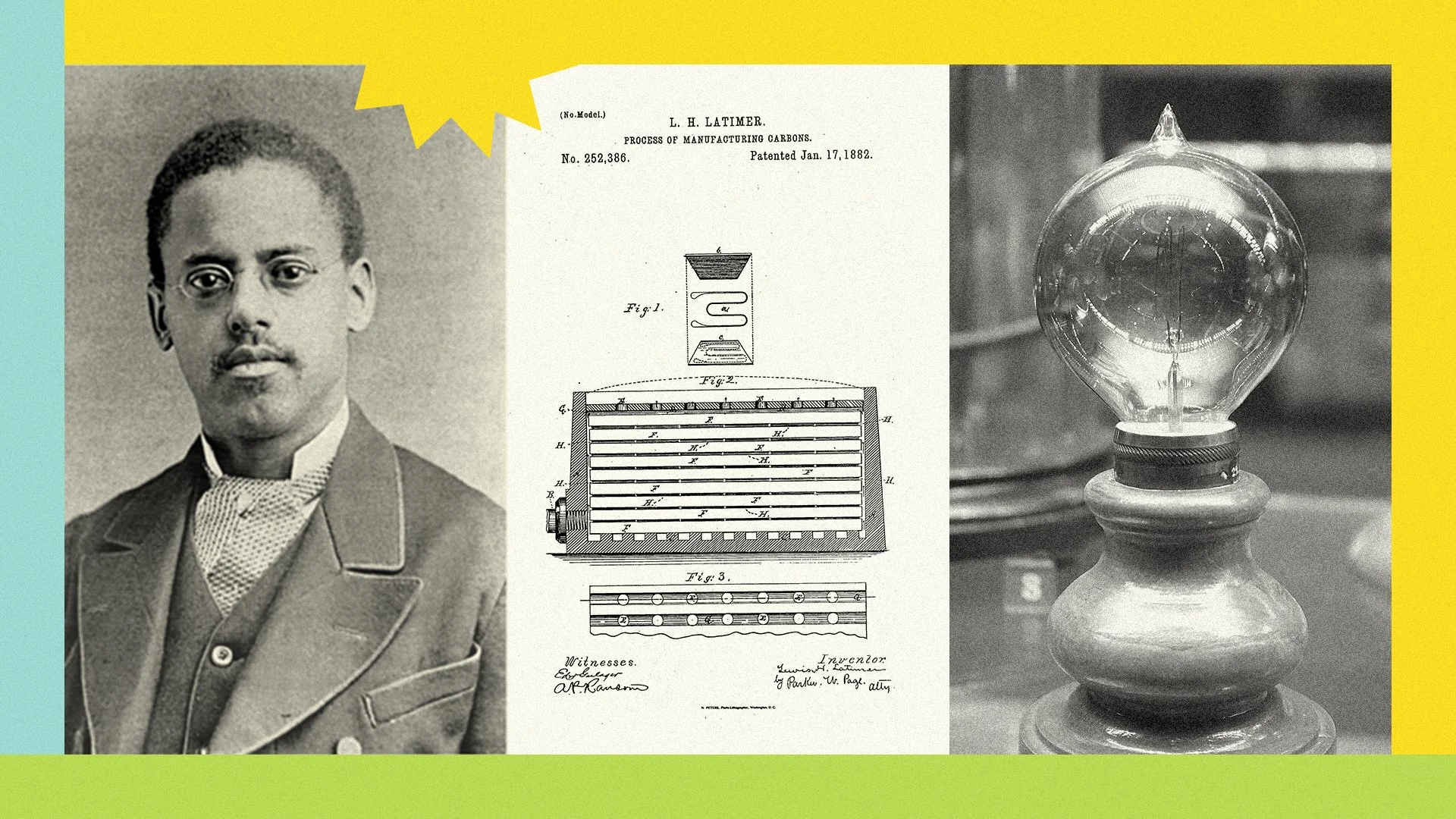
Photo Illustration: Humanizing History Visuals. Photos: Daderot, CC0, Lewis H. Latimer (1848- 1928), Public domain via Wikimedia Commons
Welcome to Humanizing History™! Every month, we feature a central theme. Each week, we dive into different areas of focus.
This month’s theme: Humanizing STEM, The Stories Behind What We Teach
This week’s focus: Hidden History, a facts-based narrative to highlight someone who changed history
Today’s edition of Humanizing History™ is about 1,200 words, an estimated 4-minute read.
The Why for This Week’s Topic
What can a drawing do?
Sometimes it can show us a way to see, or turn an idea into something other people can understand. Sometimes it’s a blueprint, a record, a patent. And sometimes it can become a way to enter a room or profession, especially when other forms of access have been denied to you and your family, for generations.
For Lewis Latimer, drawing — or learning how to create technical and patent drawings through observation — would change his life and shape technologies that changed the lives of countless others.
This month, we’re examining the human stories already embedded within STEM.
We’ve explored the mathematics, computing, and satellite science behind GPS through the story of Dr. Gladys West.
We’ve unearthed fossils to examine the life of Mary Anning, an early paleontologist whose work would change what many scientists understood about life, extinction, and the history of our planet.
And we’ve looked closely at the living world around us — through the lens of a trailblazing botanist, Ynés Mexía.
Today, we’re featuring Lewis Latimer.
His life invites questions like: “Who gets to be an inventor? And what does an inventor look like?”
His work also reveals invention as something more nuanced than a single brilliant idea. It also tells a more layered story of observation, questions, skills, denied opportunities, access, collaboration, imagination, persistence, and ultimately, credit and ownership.
The Story and Impact of Lewis Latimer
The heart of Lewis Latimer’s story begins before he was born.
In 1842, his parents, Rebecca and George Latimer, freed themselves from unjust enslavement in the state of Virginia and made their way to Boston. Shortly after their arrival, George was arrested after his former enslavers sought to reenslave him. At the time, federal law allowed enslavers to pursue freedom seekers across state lines, even if slavery was abolished there.
George Latimer’s arrest became a focal point for many abolitionists, such as Frederick Douglass and William Lloyd Garrison. Douglass wrote publicly about the case: “And why was this — what crime had George Latimer committed? He had committed the crime of availing himself of his natural rights.”
Ultimately, Reverend Nathaniel Colver paid $400 to secure George Latimer’s “freedom.” The case helped galvanize the passing of the Personal Liberty Law, known as the Latimer Law — prohibiting state officials from assisting with the detention of freedom seekers in Massachusetts.
Just six years later, Lewis was born.
To better understand Lewis Latimer — the barriers he had to overcome and the impact he would have — we should take a moment to reflect on the world he was born into: his family had already fought and risked everything for the human right to determine their own lives.
So how do you build a career when access to education and opportunity — when legal personhood — was / is not guaranteed?
Lewis helped his father in his barbershop and worked other jobs, including hanging wallpaper. At sixteen, Lewis joined the Union Navy during the Civil War. After the war, he found work as an “office boy” at a patent law firm.
Lewis did not have an engineering degree or a laboratory experience. Instead, he observed carefully. He studied the draftsmen in the office. He read books. He taught himself mechanical drawing and how to use drafting tools. Eventually, he became a draftsman — a move that took his salary from $3 a week to $20.
Learning how to draw — specifically, patent drawings — opened the door. And those drawings would continue to open doors.
Later in his career, Latimer worked with Alexander Graham Bell on drawings for Bell’s telephone patent application.
Latimer did not invent the telephone, but his technical drawings helped translate Bell’s ideas into the detailed visual documents needed for the patent process.
This highlights an important idea: we often imagine invention as a single moment, or the product of a single mind or hand. But it is often influenced by many minds, many hands.
Which brings us to another invention, often told through a single name: the light bulb.
By the time Latimer entered the electric-lighting industry, incandescent lighting was developing rapidly. But making lamps long-lasting and practical still presented significant technical challenges. One early incandescent lamp, developed by Thomas Edison’s team, for example, lasted little more than 14 hours.
While working at Hiram Maxim’s electric lighting company, Latimer learned more about the emerging technology, and developed an improved process for manufacturing carbon filaments. In 1882, Latimer patented the process himself, helping make incandescent lighting more “practical, affordable, and longer-lasting.”
This was not a simple achievement with a small outcome. His contribution made lighting more practical to produce and use. This would transform everyday life in countless ways and places: homes, businesses, streets, cities, work, leisure, the ways people could live after the sun had set.
Latimer’s impact extended beyond electricity.
He was often the only Black American in the professional spaces where he worked. In 1918, he became the only Black American among the 28 people who were a part of Edison Pioneers.
Latimer was prolific. He wrote a technical book about electric lighting and taught mechanical drawing and English to people who immigrated to the U.S., at the Henry Street Settlement in New York City.
An artist, Latimer also wrote poetry and plays, played the flute, and painted.
Eventually, Latimer also had a family of his own, helping ensure that his daughters had access to formal education that had not been available to him in the same way.
Latimer’s story was not just about invention. His impact included helping others to learn.
Eventually, Latimer's career came to a close as his eyesight began to deteriorate.
His former home in Queens has been turned into a museum. His drawings, writing, and art continue to fill the space — inspiring a new generation of students to be curious and innovate.
STEM Connections
Studying Lewis Latimer’s life gives students an opportunity to see STEM not simply as a collection of finished inventions, but as a nuanced process shaped by many people, influences, iterations, and the world around them.
His story can help students explore:
Engineering and Design: How do we move from identifying a problem to designing, testing, and improving a solution?
Materials and Electrical Science: How do the properties of materials affect how technologies work? What challenges did engineers have to solve to make electric lighting practical?
Technical Drawing and Communication: How can a drawing translate an idea into something another person can understand, build, test, or patent?
STEM and Humanizing History: How do laws, access to education, race or ethnicity, labor, industry, and historical context shape who gets the opportunity to participate in fields like STEM, and whose contributions get remembered?
Humanizing the Curriculum
Latimer’s story gives us an opportunity to move beyond teaching students about an inventor and invite them to engage in the process of innovation themselves.
What if an exercise began with a problem? What could students observe, question, draw, test, change, and try again?
As you think about your own STEM curriculum — and beyond — consider:
What problems do you want your students to learn how to solve?
What skills — and access and opportunities — do they need in order to be able to solve them?
Lewis Latimer reminds us to look deeper and unpack single stories: the ones some may have for the enslaved, as well as the ideas we may hold about what constitutes an inventor and what makes an invention.
His life reveals the power we have to imagine, create, improve, and build something that matters — not just in our lives, but for the multitude.
Theme: