
The Human Story Behind Paleontology and Extinction: Mary Anning
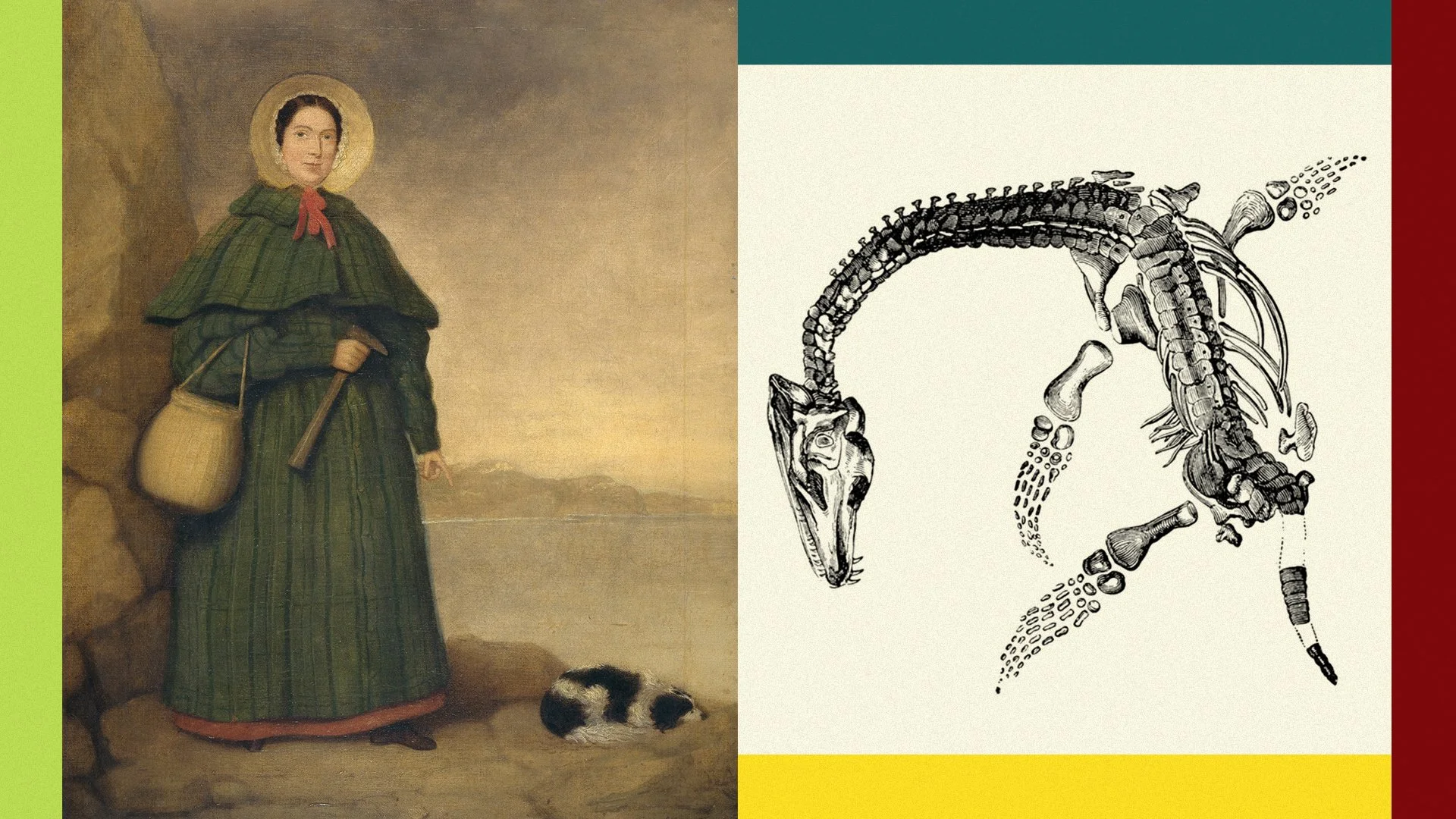
Photo Illustration: Humanizing History Visuals. Photos: William Buckland, Public domain, via Wikimedia Commons
Welcome to Humanizing History™! Every month, we feature a central theme. Each week, we dive into different areas of focus.
This month’s theme: Humanizing STEM, The Stories Behind What We Teach
This week’s focus: Hidden History, a facts-based narrative to highlight someone who changed history
Today’s edition of Humanizing History™ is about 1,000 words, an estimated 3½-minute read.
The Why for This Week’s Topic
What can we learn by paying attention to something we don't yet know how to explain — because the concept, the language, or even the possibility of it doesn’t quite yet exist?
So much of scientific discovery has begun there: with observation, questions, something that doesn’t fit what we think we know.
This month, we’re examining stories to illustrate how humanizing content can enhance curricula, including STEM.
Last week, we explored the mathematics, computing, and satellite science behind GPS through the story of Dr. Gladys West.
This week, we’re traveling back to the early 1800s, to the rocky beaches of Lyme Regis on England’s southern coast. Here, a young girl began collecting evidence of life that had disappeared millions of years before her — and our — time.
Her name was Mary Anning.
And some of what she found would help change what many scientists understood about life, extinction, and the history of our planet.
The Story and Impact of Mary Anning
Mary Anning was born in 1799, in a small coastal town in Dorset, England — a region that is now known as the Jurassic Coast, because of the layers of Jurassic rock exposed along the beaches here.
Her father was a cabinet maker. In search of ways to provide more for the family, Mary’s father combed the cliffs and beaches for fossils, which he sold to visitors who collected “curiosities.”
Mary began joining him when she was young, learning how to search the landscape and recognize fragments hidden within the rocks.
Tragically, when Mary was still a child her father died after falling from the cliffs and suffering from tuberculosis, leaving the family with little money.
Determined to provide for her family, Mary continued to hunt for fossils along the coast. She read geology books and carefully studied the fossils and rocks she found — gaining an extraordinary ability to recognize something unusual within the landscape.
In 1811, at around 12 years old, Mary and her brother Joseph came across an unusual skull, embedded in the cliffs. Over the following months, Mary painstakingly uncovered the rest of the skeleton. It was unlike anything they had seen before.
Some said it looked like a “half fish, half lizard.” The animal was eventually identified as an ichthyosaur, a marine reptile that lived about 200 million years ago!
But in Mary’s time, there wasn’t yet a familiar category for animals like this. The word “dinosaur” hadn’t even yet entered scientific use.
So what exactly was Mary looking at? And why did it look so different from anything alive? And perhaps most profoundly: Why was it no longer here — breathing on Earth?
The idea that a species could become extinct was still controversial among some scientists.
Mary’s fossils were evidence that Earth's past was not simply an older version of the world people knew. Instead, it was a world filled with a remarkable diversity of organisms, many of which had completely disappeared — leaving behind only a fossil record.
And Mary kept finding and documenting such fossils.
In 1823, she discovered an almost complete skeleton, another marine reptile: a plesiosaur.
This animal was considered so strange that some prominent scientists questioned whether the specimen was even real. George Cuvier, a leading naturalist at the time, initially suspected that the skeleton might have been assembled from different animals. Other scientists examined the evidence and ultimately accepted it as genuine.
With each fossil, Mary helped reveal a prehistoric world that many scientists were still learning how to imagine.
She went on to discover and document thousands of fossils, including fish, sharks, invertebrates, and a pterosaur — the first of its kind found outside of Germany.
She also helped scientists understand coprolites, or fossilized animal feces, which could provide clues about how such prehistoric animals ate or lived.
Her findings changed our understanding of Earth, extinction, and life itself.
And yet, Mary’s place within the formal scientific community was not embraced.
As a “working class” woman with little formal education, living at a time when scientific institutions favored men, especially men with greater economic and social standing, Mary was excluded from many of the circles in which her very discoveries were discussed.
She could not become a member of the Geological Society of London, even as some geologists sought her expertise, purchased her fossils, and discussed her discoveries in their work.
Mary continued to work, study, and sell fossils to support her family.
Today, Mary is often depicted with her fossil-hunting dog, Tray, who accompanied her on many of her expeditions along the coast. An image that reminds us that the person behind such discoveries was more than an overlooked name.
Unfortunately, Mary died in 1847, at the age of 47. By then, many leading geologists had come to respect her knowledge and contributions, even though the scientific institutions of her time continued to deny her full membership. Her scientific impact would be recognized with greater depth and celebration in the generations that followed.
STEM Connections
Mary Anning’s story opens a door into paleontology and beyond.
Her work can help students explore:
Geology: How rocks and geological layers preserve evidence of Earth’s past
Paleontology: How scientists use fossils to reconstruct organisms and ecosystems that no longer exist
Anatomy: How studying bones and body structures can help us understand how extinct animals lived
Extinction: How fossil evidence reveals that species can become extinct
Scientific Observation: How careful observation, documentation, comparison, and questioning contribute to scientific knowledge
Humanizing the Curriculum
Mary’s life and work reminds us that scientific discovery does not always start with certainty. Sometimes, it begins with a noticing. A steadfast wondering. A question: What am I really looking at?
Mary dug a little deeper, and because she did, our understanding of Earth’s history, and life itself, also expanded.
As you think about your own STEM curriculum — and beyond — consider:
What can students learn by paying attention to something they don't yet know how to explain?
Where might there be an opportunity for students to experience science as a process of observation, questioning, uncertainty, and discovery?
As Mary did, sometimes it’s important to look at something again. To take our time to carefully unearthing it. Because sometimes, another — perhaps more humanizing — story is just below the surface.
Theme: