
The Human Story Behind Botany and Curiosity: Ynés Mexía
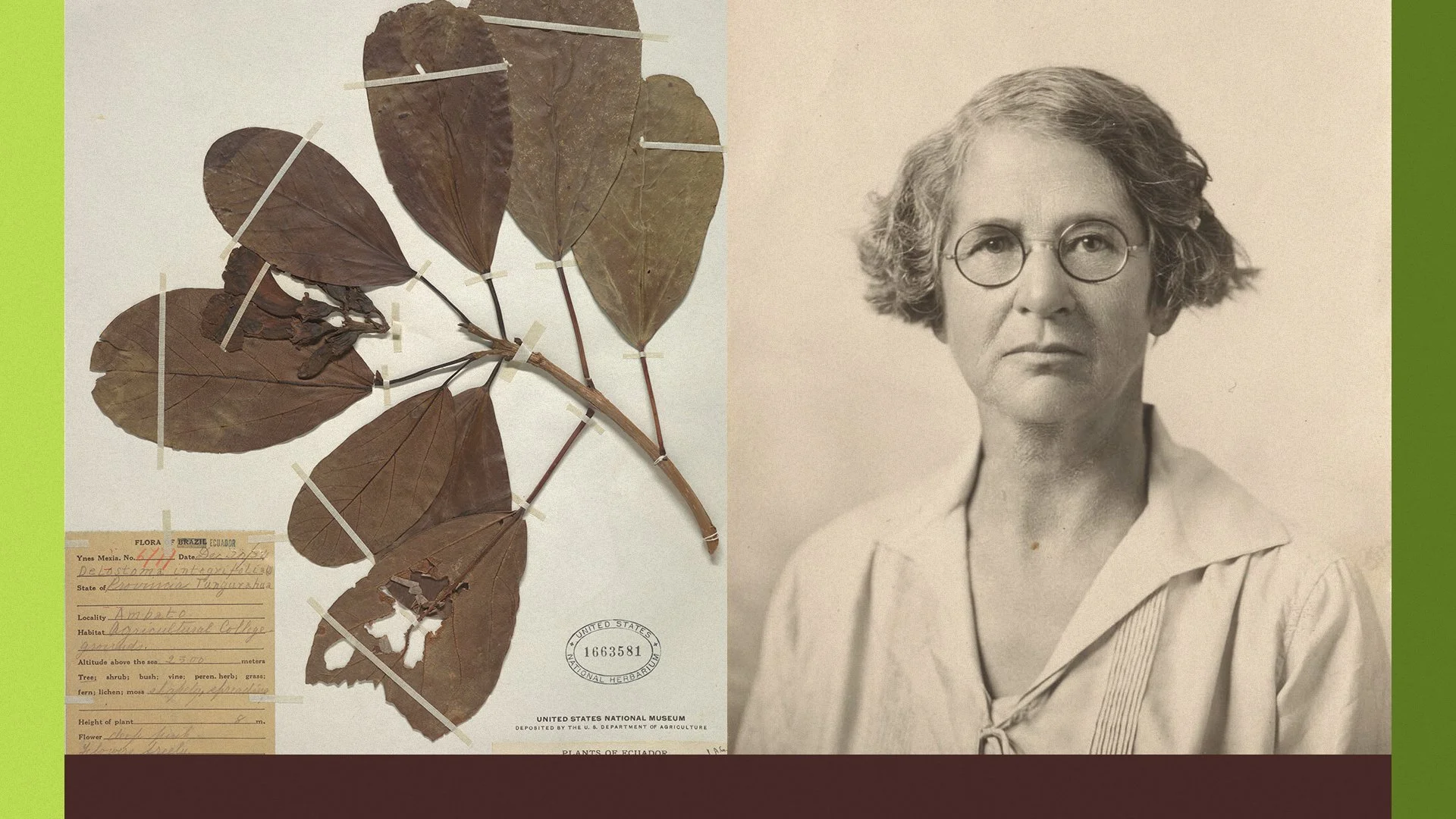
Photo Illustration: Humanizing History Visuals. Photos: Ynes Mexia, CC0, The Bancroft Library, Public domain/via Wikimedia Commons
Welcome to Humanizing History™! Every month, we feature a central theme. Each week, we dive into different areas of focus.
This month’s theme: Humanizing STEM, The Stories Behind What We Teach
This week’s focus: Hidden History, a facts-based narrative to highlight someone who changed history
Today’s edition of Humanizing History™ is about 1,200 words, an estimated 4-minute read.
The Why for This Week’s Topic
What if you didn’t unearth your life’s work until your 50s? And curiosity didn't have an expiration date.
This was the case for a botanist who didn’t start their scientific journey until they were 51 years old. Over those next 13 years, they would become one of the most accomplished plant collectors of their time — traveling thousands of miles across the Americas, collecting more than 145,000 specimens.
This month, we’re examining the human stories already embedded within STEM.
First we explored the mathematics, computing, and satellite science behind GPS through the story of Dr. Gladys West.
Last week, we traveled back to the early 1800s, to examine the life of Mary Anning, an early paleontologist whose work would change what many scientists understood about life, extinction, and the history of our planet.
This week, we’re moving from looking beneath the Earth’s surface to looking closely at the living world around us — through the lens of a trailblazing botanist.
Her name was Ynés Mexía.
And her life story illustrates what may happen when we apply a lens of curiosity to the world that surrounds us.
The Story and Impact of Ynés Mexía
Ynés Enriquetta Julietta Mexía was born in 1870 in Washington, D.C., to a Mexican diplomat father and a U.S. American mother who also came from a family with significant cultural and social capital.
Throughout her life, Mexía lived in both Mexico and the United States — at one point, she lived in Mexia, Texas, a town founded by some of her ancestors.
Ynés was a quiet child who spent much of her time reading. When she was nine, her parents separated, and Ynés was sent to boarding school. From there, her path to science was far from linear.
After two marriages — one ending in illness, the other reportedly ending after a spouse “bankrupted” her family business — Mexía eventually made her way to San Francisco, where she got involved in emerging environmentalism. She joined the Sierra Club and Save the Redwoods League.
At the age of 51, she enrolled in science and natural history courses at the University of California, Berkeley. There, she discovered botany and realized how much she loved collecting plants.
Mexía said: “I have a job where I produce something real and lasting.”
Documenting the living world matters because we cannot understand, study, or protect what we have not taken the time to first notice.
Curiosity was central to her scientific practice.
In the 1920s, Mexía began traveling on long expeditions. Across a 13-year career, her work took her from the top of North America in Alaska to the southern tip of South America in Argentina.
At the age of 59, she embarked on one of the greatest adventures of her career: a 2.5-year, 3,000-mile journey through the Amazon, where she traveled by both steamship and canoe. At a time when women were rarely expected — or encouraged — to undertake this kind of mostly independent fieldwork, Mexía pushed ahead, traveling through remote landscapes, often with a local guide and not a large team.
Mexía did not see her gender as a limitation. She once said: “I don’t think there’s any place in the world where a woman can’t venture.” So she went.
Mexía walked, hiked, climbed, fell, broke a few ribs, rode horses, slept outside, collected samples, pressed plants, took photographs, filled scrapbooks, and wrote captions.
Over time, she amassed a collection of more than 145,000 specimens of plants! But she was doing more than simply gathering plants. Mexía was collecting, naming, describing, and classifying them — work that helped to build the scientific knowledge we use to understand biodiversity.
Her work contributed to the documented discovery of more than 500 plant species, 50 of which were named in her honor.
To study biodiversity is also to learn how to pay attention to place. Ynés Mexía did not simply study plants; she also studied the living world around her. And she was a fierce conservationist. Her work with the Sierra Club and redwood conservation placed her among early advocates protecting California’s redwood forests.
Her work as a botanist and a conservationist overlapped: pay attention to what is here, understand it, and recognize that it is worth protecting.
It can be argued that Ynés Mexía was a trailblazer. She was also an “imperfect person,” as the California Academy of Sciences describes her.
Some of Mexía’s writings about Indigenous People — who were often her guides on expeditions — contained language that reflected "privilege and elitism," including racist and colonial ideas such as referring to Indigenous people as wilder than wildlife. At the same time, many historical accounts describe Mexía as an advocate. The National Park Service writes: “She advocated for Indigenous rights in the areas she collected, valuing their knowledge, perspective, and right to the land.”
Such a contradiction is worth noting.
Mexía clearly brought curiosity to the natural world: What lives here? What exactly is this plant? What haven’t we documented yet?
And, we may take a moment to consider what might happen — to our biases, our limitations — if we apply a similar curiosity to ourselves: Why do I understand this place the way I do? Whose knowledge am I utilizing, collaborating with, benefiting from, overlooking? What assumptions am I bringing with me?
Curiosity can expand what we know about the physical world. Curiosity can also encourage us to examine the sociocultural assumptions we may bring to that world.
STEM Connections
Studying the contributions of Ynés Mexía’s work can open doors into botany and beyond.
Her work can help students explore:
Botany: How scientists study plants and plant diversity
Taxonomy: How organisms are classified and named
Ecology: How living organisms interact with one another and their environments
Biodiversity: How scientists document and understand the variety of life on Earth
Scientific Observation: How careful observation, documentation, comparison, and questioning contribute to scientific knowledge
Conservation: How scientific knowledge can inform efforts to protect ecosystems and species
Humanizing the Curriculum
Ynés Mexía’s story invites us to think about curiosity not simply as a scientific skill, but as a way of engaging with the larger, fuller, more holistic world.
When we teach historical figures — including those who worked in STEM — we can tell a complex truth about someone who contributed meaningful knowledge while examining the assumptions and limitations they may have also carried.
With younger students or children, consider asking:
What do you notice when you slow down and really look at something?
What questions might you ask about a plant, animal, or place you’ve never seen before?
Can two people look at the same place and notice different things?
With older students or children, consider asking:
How can curiosity help us learn more about the natural world — and also help us question our own assumptions?
What happens when we value knowledge from one source while overlooking the full personhood of those who may hold such knowledge?
Can a person contribute important knowledge while also holding beliefs that warrant questioning? What evidence helps us understand that contradiction?
Ynés Mexía reminds us that curiosity doesn’t have an expiration date. But it does ask: What else is out there? What else might I be missing?
This is where curiosity can become a scientific skill. It can help us reveal what we don’t yet know. And it can help us recognize the limits of what we think we may already know, but would benefit from further questioning, expanding, and humanizing.
Theme: