
The Human Story Behind GPS: Gladys West
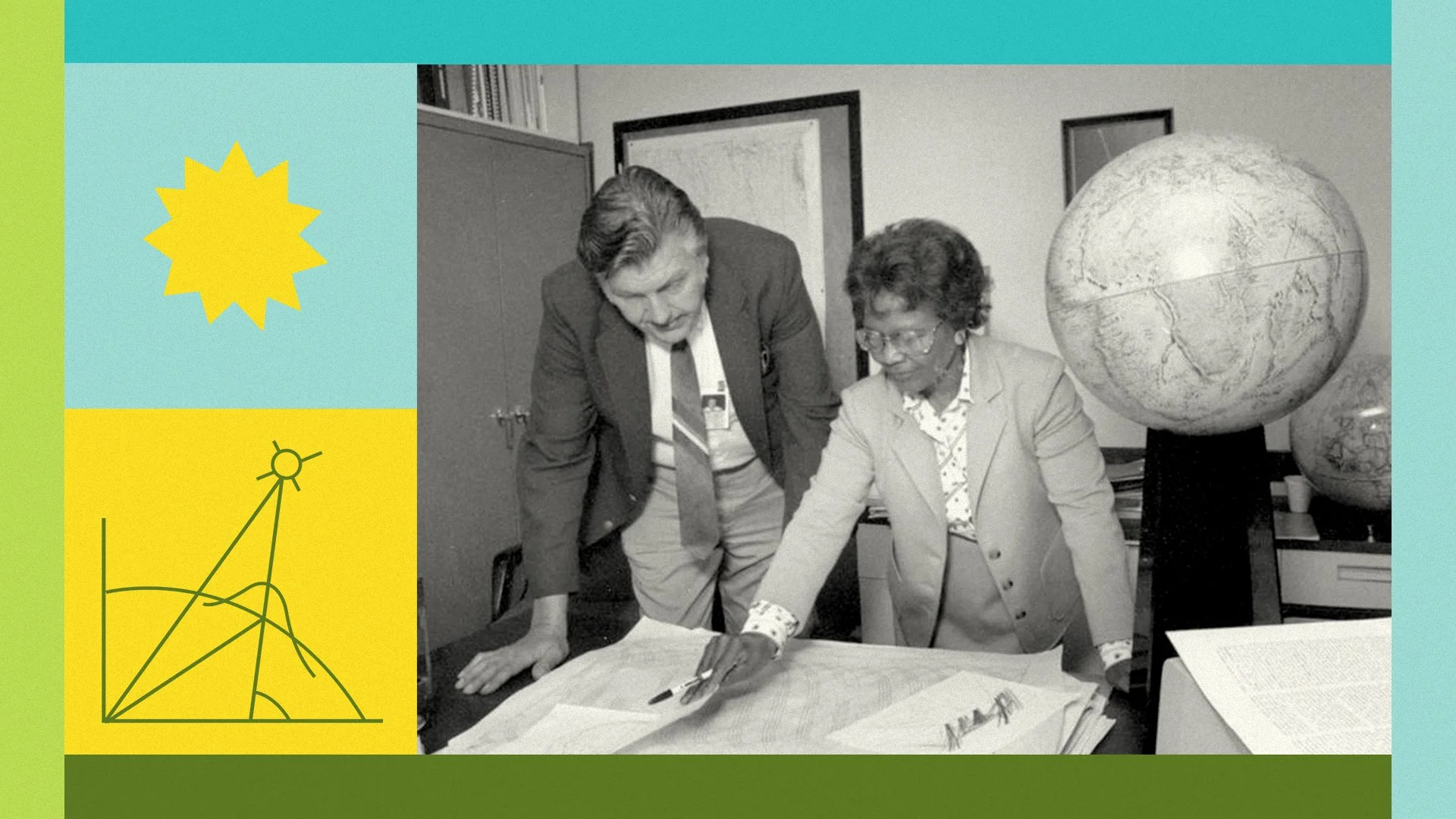
Photo Illustration: Humanizing History Visuals. Photo: U.S. Navy
Welcome to Humanizing History™! Every month, we feature a central theme. Each week, we dive into different areas of focus.
This month’s theme: Humanizing STEM: The Stories Behind What We Teach
This week’s focus: Hidden History, a facts-based narrative to highlight someone who changed history
Today’s edition of Humanizing History™ is about 1,000 words, an estimated 3½-minute read.
The Why for This Week’s Topic
Across the world, every day, billions of people use GPS-enabled technology. They open a screen. They type in an address. Within seconds, a route appears — telling them where they are now, showing how to get to where they want to go, and tracking their progress along the way.
GPS can feel almost invisible now. It’s simply available — built into phones, cars, watches, and other technologies many of us use every day.
But underneath that moving blue dot is an extraordinary amount of mathematics, physics, computer science, engineering, as well as trial and error, human labor, and evolving equations — all working together to integrate satellite technology and map the shape of our planet.
And much of that story leads us to a mathematician named Gladys West.
Over the years, I’ve heard from many STEM educators who are curious about how a “Humanizing History” lens connects to the subjects they teach — and how they, too, can bring more humanizing content into their classrooms.
So, to expand our interdisciplinary lens, this month, we’re exploring the human stories already embedded within STEM.
This week, we start with Dr. Gladys West.
The Story and Impact of Gladys West
Gladys West was born in 1930, during the Great Depression, and grew up in rural Virginia. Her parents were tobacco farmers.
As a child, Gladys worked on the farm in the mornings, attended school, and returned to the farm in the evenings.
She grew up during an era of legally enforced racial segregation — when federal, state, and local governments upheld laws and systems that unjustly denied Black Americans equal access to education, employment, voting, and opportunity.
An exceptional student, West was encouraged by her mother and teachers to attend college. She graduated as valedictorian of her high school class, and went on to earn a scholarship to Virginia State University, one of Virginia’s HBCUs.
West studied mathematics, earning both an undergraduate degree and a master’s degree, and worked as a teacher before being hired in 1956 at the Naval Proving Ground in Dahlgren, Virginia.
She was the second Black woman hired at the facility, and was only one of four Black employees there at the time.
When she began her career, West did most of her mathematical calculations by hand and was known for her accuracy. Eventually, she began working with some of the most powerful computers of her era, using satellite data to develop increasingly precise mathematical models of Earth.
In her own words, West states: “I was hired to write the mathematical equations in computer language and check all the physics. I would connect data from the satellites and then did solutions to find exact positions.”
It’s important to note that at the time, this was not a simple mathematical problem set.
Earth isn’t a perfect sphere. Influenced by variations in gravity, terrain, and the distribution of mass across the planet, Earth has an irregular shape. Scientists use the term geoid to describe a model of Earth’s mean sea-level shape.
West’s work helped create increasingly precise models of that shape, which are essential to the calculations used to determine satellite positions and, eventually, enable increasingly accurate positional systems.
Much of her work, at the time, was classified. West knew she was doing important, even pioneering work, but she was not made fully aware of the wider implications it would eventually have on society.
For decades, she remained largely unknown outside scientific and military circles. But eventually, West’s contributions began to receive wider recognition.
In 2018, she was inducted into the Air Force Space and Missile Pioneers Hall of Fame — a recognition of the decades of mathematical and computational work she had done behind the scenes.
The work — the legacy — West had built through equations, computers, satellite data, and mathematical models of Earth had laid important groundwork for a technology that would transform how billions of people navigate the world.
And just to add a bit of humor and nuance — humanity — to her story, even though West helped make GPS possible, she admitted in her later years that she still preferred to use “old-fashioned paper maps.”
STEM Connections
Gladys West’s story opens the door to far more than GPS. Her work connects multiple STEM disciplines — showing how mathematics, science, computing, and technology can come together to solve complex problems.
These connections can offer an entry point for planning STEM units — or simply for pausing with students to explore the human story behind the concepts they’re learning, and even the objects they may themselves hold in their own hands.
Mathematics: How do you mathematically measure a world that isn’t perfectly shaped? West’s work involved mathematical modeling, geometry, algorithms, approximation, and solving complex problems using numerical data.
Geodesy & Earth Science: How do we measure the shape of an entire planet? West’s work offers an entry point into the science of measuring and modeling Earth.
Computer Science: West translated mathematical equations into computer language and worked with increasingly powerful computers to process enormous quantities of satellite data.
Physics: Satellite motion, gravity, tides, and the forces that affect how objects move around Earth are also integral pieces of the story.
Engineering & Technology: How do mathematics, physics, computing, and data come together to create a technology people use every day?
Geography: Coordinates, location, mapping, navigation, and our relationships to physical space connect to West’s story as well.
Humanizing the Curriculum
The life and contributions of Gladys West remind us that the mathematics behind GPS did not simply appear. It came from a person asking questions, solving problems, writing equations, studying the Earth, working with data, and finding ways to understand the larger world — while also navigating social forces and barriers she should never have had to endure.
As you think about your own STEM curriculum — and beyond — consider:
What does it take to make something we cannot easily see — the shape of Earth, the movement of a satellite, or even our own location — measurable?
What changes when we teach STEM not simply as a collection of concepts and formulas, but as a human story riddled with questions, curiosity, problem-solving, and possibility?
The many fields of STEM are already “human.” Stories are already there. Sometimes, we simply have to look for them — and do our best to make them more visible.
Theme: