
Field Trip: Coachella Valley, California
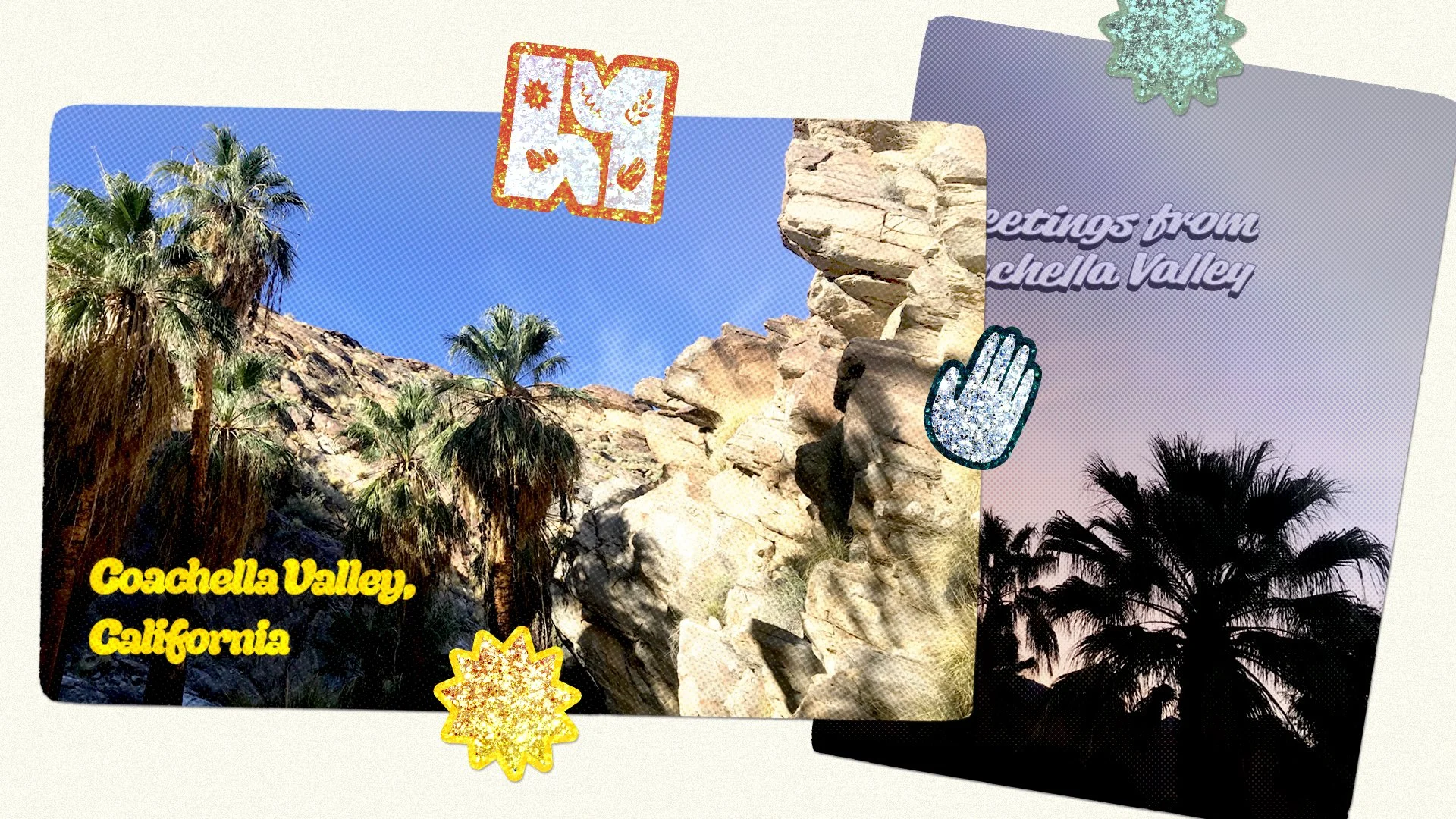
Photo Illustration: Humanizing History Visuals. Photo: Humanizing History.
Welcome to Humanizing History™! Every month, we feature a central theme. Each week, we dive into different areas of focus.
This month’s theme: Summer Field Trip, The Shape of Home
This week’s focus: Field Trip, where we highlight significant historic, archaeological, and cultural sites around the world
Today’s edition of Humanizing History™ is about 1300 words, an estimated 4½-minute read.
The Why for This Week’s Topic
Imagine standing on the desert floor of California’s Coachella Valley on a July afternoon. The temperature climbs well above 110°F (over 43°C).
The sun blazes across the desert landscape. Hot bare rocks from the foothills of the surrounding mountains radiate their own heat, like an oven. Your heart beats hard, like a drum. It’s an otherworldly kind of hot.
Now imagine stepping aboard a rotating aerial tram, suspended by a 2.5-mile-long cable. Within fifteen minutes, you lift off the valley floor — dotted with palm trees — and arrive near the summit of San Jacinto Mountain, an imposing force that rises more than 10,800 feet above sea level.
The desert has been replaced by cool mountain air and forests of pine trees. The temperature can be 30 to 40 degrees (F) cooler up here.
Along the journey — riding the world’s largest rotating tram car — you’ve traveled through five distinct “life zones.” It’s a transition some have described as the “botanical equivalent” of going from Mexico to Canada.
Few places on Earth compress such a dramatic ecological change into such a short distance.
Such a dramatic landscape invites awe.
How can two seemingly opposite worlds exist so close together? And how do people come to belong to such a place?
For thousands of years, people have done more than survive in the Coachella Valley. They have learned its rhythms. They understood its seasons. They have built relationships with the landscape. They made it home.
This month, we’re returning to our Summer Field Trip series.
Last summer, we explored how people shaped the earth itself — carving cliffs, excavating rock, and transforming landscapes into places of meaning.
This summer, we’re asking a similar expansive question: How do landscapes shape the ways humans live — and how do humans build relationships with those landscapes in return?
Today, our journey begins in California’s Coachella Valley:
A place where desert and mountain meet, where temperatures shift dramatically with elevation, and where generations of people have found ways to belong to this landscape.
A Relationship with Place
Long before highways crossed the desert floor or aerial trams climbed the mountains, the Cahuilla people developed a deep understanding of the Coachella Valley.
To survive the desert is one thing. To build a home is another.
For thousands of years, the Cahuilla lived throughout a vast territory stretching across the Coachella Valley and surrounding mountain ranges. Beyond surviving difficult conditions, their knowledge was rooted in understanding relationships — among seasons, plants, animals, water, elevations, and communities.
For many Cahuilla families, life was not confined to a single location on a map. Home stretched across a 2,400-square-mile landscape.
Across generations, the Cahuilla Nation cultivated an embodied knowledge system — one rooted in careful observation and deep relationship with the landscape. They understood the rhythms of the valley and mountains: where water could be found, where plants grew, when resources were available.
Many Cahuilla families built homes near natural oases. They developed methods to channel water from mountain slopes. The California fan palm — native to this region — was especially important, providing material for baskets, sandals, roofing, and other everyday items. Mesquite, agave, yucca and other native plants provided food, medicine, and fiber. Acorns were harvested from oak trees in the mountains during the fall and were turned into flour. Animals were hunted across the region. Together, the desert and mountains provided a diverse network of resources — creating a landscape where food, materials, and knowledge were connected across ecosystems.
The Cahuilla also transformed materials from the landscape into technological and cultural innovations.
Bows were made from willow, mesquite, or palm fronds. Arrows were fashioned from cane, sagebrush, and arrowweed, often tipped with stone or wood. Some were even coated with toxins derived from black widow spiders and rattlesnakes. Such tools reflected a deep understanding of landscape, transforming local resources into innovative technologies for daily life.
Cultural practices were also connected to place. Tattooing, for example, was an important tradition for many Cahuilla people. Using cactus thorns or yucca needles and plant-based pigments, tattoos reflected identity, including clan relationships.
The Cahuilla also built relationships beyond the Coachella Valley through extensive trade networks, exchanging resources such as salt, obsidian, acorns, and animal skins for coastal fish, shell beads, pottery, and agricultural products.
Home, in the Coachella Valley, was more than a harsh place to endure. It was a vast homeland — one cultivated through knowledge, movement, community, and care across generations.
Living Along Gradients
Visitors to the Coachella Valley today experience this relationship with desert and mountain in a new way.
The Palm Springs Aerial Tramway carries passengers from the desert floor into an alpine forest — from palms to pines — in less than fifteen minutes. Without experiencing it firsthand, a statistic like that feels nearly impossible.
But the tram reveals something important about this landscape: sometimes the world may be defined less by hard borders, and more by gradients.
Along the mountain’s slopes, temperatures change gradually. So does plant life. And elevation. One ecosystem slowly transitions into another.
For thousands of years, people have learned to live within those gradients. The landscape offers different possibilities at different elevations, and Indigenous Peoples in the Coachella Valley — like many communities around the world — have learned how to move, adapt, and respond.
The tram makes visible something Indigenous communities have long understood: the Coachella Valley is home to awe-inspiring and challenging ecosystems existing together, along a continuum.
New Relationships With An Ancient Landscape
Today, during peak seasonal months, the Coachella Valley is home to about half a million people. And the relationship between people and the landscape continues to evolve.
Air conditioning has transformed daily life for many. Roads and highways have connected communities across the valley. Neighborhoods, pools, tourism, golf courses, wind farms, and other industries have reshaped the desert in different ways.
Agriculture represents another chapter in this ongoing relationship. Through irrigation and other forms of innovation, portions of the desert have become some of the most productive agricultural regions of the U.S. — producing crops such as lettuce, carrots, peppers, dates, and grapes that reach markets across the U.S. and the world.
But every relationship with a landscape carries consequences.
The same ingenuity that brought irrigation systems, wind farms, highways, golf courses, and dense neighborhoods into the desert has also increased demands on limited water supplies, reshaped ecosystems, and altered local climate conditions, while depending on the labor of people who often work in extreme heat and difficult conditions.
That too, is part of the story. Human innovation does not end with solving one challenge — it often creates new possibilities and responsibilities simultaneously.
Each generation may continue to ask: How do we live well — in balance — with the landscapes we call home?
A Small Invitation
When we think about “home,” we may picture a building or structure.
But across time and place, people have created homes in deserts, mountains, forests, islands, tundra, and coastlines — often by learning the rhythms of the environments around them.
The Coachella Valley reminds us that home may exist in gradients. It comes with relationships, responsibilities, and ongoing choices. It’s a story of desert and mountain, heat and elevation, continuity and change.
As you think about your own sense of home and community, consider:
What relationships help you feel connected to where you live?
What knowledge about your local landscape has been passed down — and what may have been omitted?
What responsibilities come with calling a place home?
How do we learn to live within the gradients — the changes, tensions, and possibilities — of the places we inhabit?
The Cahuilla of the Coachella Valley — like numerous communities across the world — understood that belonging to a landscape requires knowing it. Listening to it. Building relationships with it across generations.
Perhaps that is one of humanity’s rarest abilities: developing the innovations to survive a place, yes, but also learning how to belong within it.
Theme: