
Meet Katherine Johnson: Behind the Mathematical Journey to Space
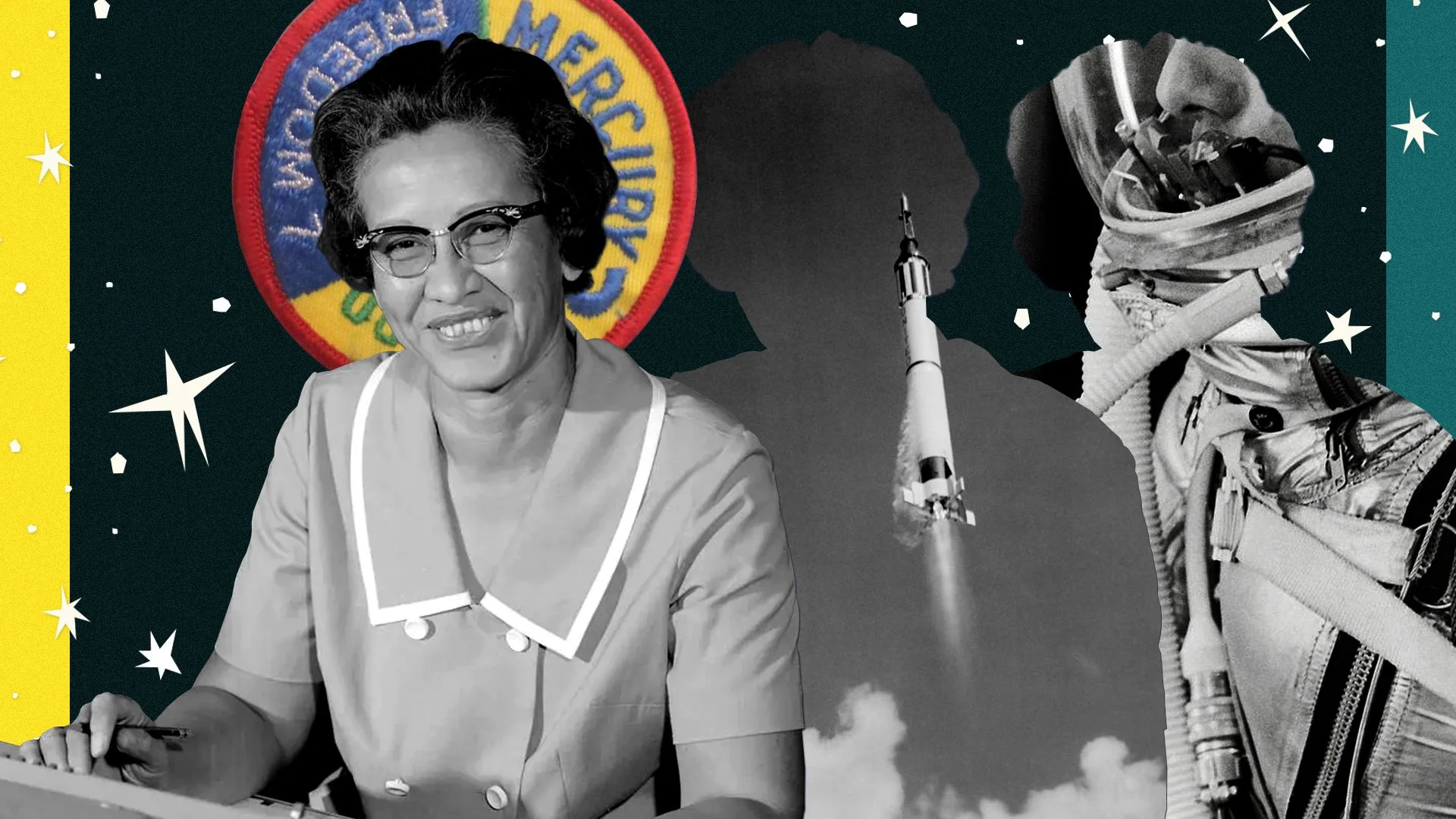
Photo Illustration: Humanizing History Visuals. Photos: NASA, San Diego Air & Space Museum Archives, via Wikimedia Commons
Welcome to Humanizing History™! Every month, we feature a central theme. Each week, we dive into different areas of focus.
This month’s theme: Behind the Story, Just Outside the Frame
This week’s focus: Hidden History, a facts-based narrative to highlight someone who changed history
Today’s edition of Humanizing History™ is about 1400 words, an estimated 5-minute read.
The Why for This Week’s Topic
In 1962, the spacecraft called Friendship 7 sat ready for launch.
Inside, astronaut John Glenn prepared to orbit Earth, wearing a pressurized suit designed for survival beyond the atmosphere. The titanium capsule, built for space flight, was compact and engineered to endure extreme heat and force.
He would not be the first human to orbit Earth. That milestone belonged to Yuri Gagarin, from the Soviet Union, just one year earlier. But his journey still carried national weight. If successful, Glenn would become the first U.S. American to do so — at the height of the “Space Race.”
Millions watched the launch on television: the rocket, the astronaut, the momentum of takeoff. But that was only part of the story.
Because the success of this mission — and John Glenn’s life — depended on something far less visible: mathematics.
Flying at speeds of 17,500 mph (or 28,000 kph), every mathematical detail had to be exact. The trajectory. The timing. The angle of reentry. Each calculation had to be precise to the utmost degree, a human life depending on it. And the world was watching.
By this time, electronic computers had begun assisting with calculations. These room-sized machines, weighing tons, could crunch numbers more quickly than humans. But they were new. And not fully trusted.
So before launch, Glenn made a request. He asked for “the girl” to check the numbers. That “girl” was a professional mathematician.
Her name was Katherine Johnson.
And this month, we’re exploring a different kind of changemaker: the people behind the stories we think we already know.
From Bayard Rustin, to Eleanor Roosevelt, to Rosalind Franklin — we’ve looked beyond the spotlight.
This week, we turn to the numbers behind spaceflight, and the people who made the improbable precisely possible.
Who Was Katherine Johnson?
Long before personal computers existed, Katherine Johnson was part of a group of mathematicians often called “human computers” — people who performed complex calculations by hand, forming an essential foundation of early aerospace research.
Born in 1918, in White Sulphur Springs, West Virginia, Katherine Johnson showed an extraordinary aptitude for numbers from an early age. She graduated high school at just 14, and by 18, she had completed college degrees in mathematics and French.
At just 15 years old, one of her professors recognized her exceptional ability and created a course — analytic geometry — specifically for her. Using mathematics to describe motion and shape, as well as her propensity for asking questions, would become central to her life’s work.
But, unfortunately, talent alone did not shape her path.
In the early 20th-century United States, opportunities were constrained by race and gender. Segregation laws and discriminatory practices unjustly shaped where people could study, work, and even move through daily life.
And yet, Johnson persisted, against the odds, as a Black woman who carved a career in mathematics.
A shift came in 1941.
FDR signed an Executive Order prohibiting racial discrimination in the defense industry and federal employment. This policy change opened doors that had long been closed, including the National Advisory Committee for Aeronautics (NACA), the agency that would later become NASA.
In the years that followed, NACA began hiring Black women as mathematicians. But access did not mean equality.
This group of Black women mathematicians — including Johnson, who joined in 1953 — were placed in a segregated unit at Langley Research Center, known as the “West Area Computers.” (White women were assigned to “East Area Computers.”) They performed the same essential calculations as their colleagues, but under unequal conditions: separate workspaces, separate dining areas, separate bathrooms, and limited recognition.
By the time NACA became NASA in 1958, thousands of women were contributing to aerospace research. Katherine Johnson was not the first, and she was not the only. But her impact was extraordinary, as she contributed to something beyond mathematical computation — something not easily measured in numbers.
Johnson pushed the boundaries placed around her. When she was told women were not included in certain research meetings, she attended anyway, pointing out that no official mandate prohibited her presence.
Her temporary assignment to an all-male flight research division became permanent. From there, her work began to shape the future of space exploration. She earned a reputation, one that John Glenn would later trust with his life.
What She Did, And Why It Mattered
Spaceflight is often remembered in visual moments: liftoff, orbit, landing. But propelling those moments are thousands of calculations, determining whether a mission succeeds or fails.
In 1961, Katherine Johnson calculated the trajectory for the Freedom 7 mission, a roughly 15-minute journey that briefly carried Alan Shepherd into space, making him the first U.S. American to do so.
Soon after, she worked on the mission that would send John Glenn into orbit. His spacecraft would circle Earth three times before reentering the atmosphere and landing in a precise location in the Atlantic Ocean, where a NASA helicopter and recovery team waited to extract him.
When electronic computers produced orbital calculations for this flight, Glenn requested that Johnson be the one to verify them by hand. “If she says they’re good,” he said, “then I'm ready to go.” Only after Johnson confirmed the numbers did Glenn agree to launch.
Her work didn’t stop there. Johnson also contributed to Apollo 11 — the mission that carried the first humans to the moon. Reaching the moon required extraordinary precision. It is not a stationary target, but one that moves through space, requiring calculations that account for gravity, motion, and timing across hundreds of thousands of miles (or kilometers).
Behind each mission were equations, models, minds, working with diligent precision. And curiosity, too.
Later in her life, when asked whether she would have wanted to go to space herself, Johnson answered: “If they had offered me a ride, I would have gone. In a minute. To see what was out there.”
Johnson helped make spaceflight possible, at a time when not everyone had equal access to the opportunities those paths literally charted.
So Why Don’t We Always Hear Her Name?
For many years, Katherine Johnson’s story was not widely known.
Why? Part of the answer lies in the systems she had to work within:
Katherine Johnson was a Black woman who had to endure living in a racially segregated society.
She worked in a field where women — especially women of color — were often excluded from opportunity and recognition.
Her work, though essential, also happened largely behind the scenes. Public attention tends to focus on astronauts, the visible figures, while mathematicians and engineers remain largely unseen.
But visibility is not the same as impact.
Without these calculations, there is no flight path. Without the flight path, there is no space mission.
And Johnson was not alone. She was part of a larger network — including women like Dorothy Vaughan and Mary Jackson — and many others whose names are less widely known, or not recorded at all.
Decades later, these stories began to reach a wider audience. In 2016, Margot Lee Shetterly published Hidden Figures, later adapted into a movie, which helped bring such long-overlooked contributions into public view.
Which raises another question: How many stories shape our world long before they’re ever told?
Classroom Connection
To bring Katherine Johnson’s contributions alive in the classroom, start with a simple question: What does it take to send someone into space?
Show students an image of a rocket launch. Then shift the focus.
Ask: What can’t we see here?
Introduce the idea of a “human computer” and connect it to spaceflights. What kinds of thinking, persistence, and collaboration might that require?
Share Johnson’s contributions, and from there, connect Johnson’s work to present-day STEM fields — mathematics, coding, aerospace, engineering — and explore how these roles continue to shape the world.
Let’s Pause and Reflect
We can name Katherine Johnson. But she was not the first. And she was not the only. There were others before her. Others alongside her. And many more whose names we may never fully know.
Across time and place, there are people whose work shaped the world in ways that are precise, essential, and often unseen. So what does it mean to remember?
Who gets named in history or the current story, and who remains just outside of it?
How might our understanding of history — and our present and future — shift if we widen the frame beyond what’s immediately visible?
The astronauts may be the ones we watch as they leave Earth. But behind every launch is a constellation of minds, each contributing their own form of clarity, calculation, care.
Sometimes the people who help us reach the stars are the ones who spend a lifetime guiding us — eyes up to the sky, and with two feet on the ground.
Theme: