
Meet Bayard Rustin: Behind the Story of the March on Washington
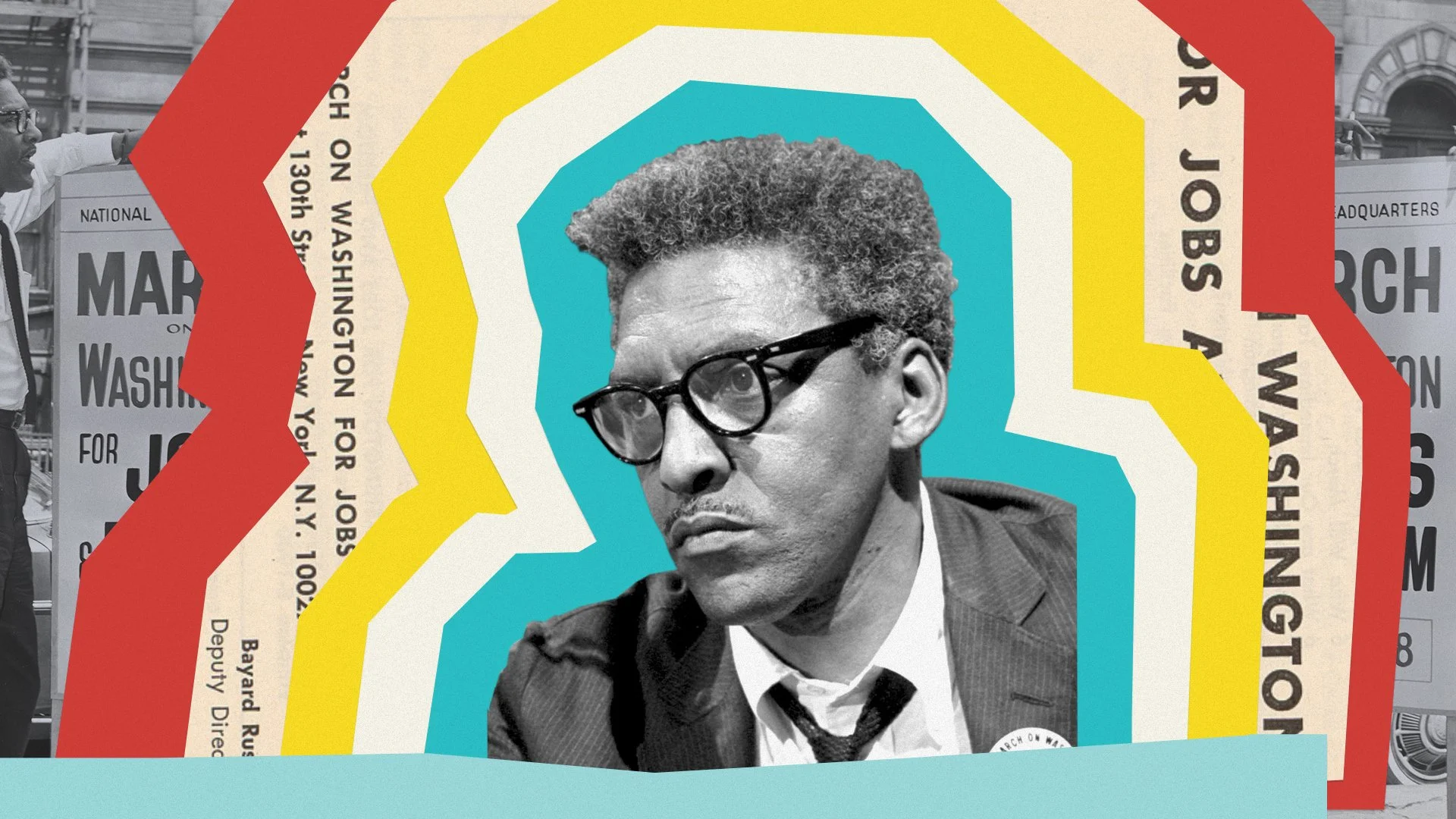
Photo Illustration: Humanizing History Visuals. Photos: Fernandez, Orlando, March On Washington For Jobs And Freedom/Library of Congress, Leffler, Warren K, Public domain/Wikimedia Commons.
Welcome to Humanizing History™! Every month, we feature a central theme. Each week, we dive into different areas of focus.
This month’s theme: Behind the Story, Just Outside the Frame
This week’s focus: Hidden History, a facts-based narrative to highlight someone who changed history
Today’s edition of Humanizing History™ is about 1100 words, an estimated 4-minute read.
The Why for This Week’s Topic
On a hot August day in 1963, an estimated 250,000 people gathered on Washington D.C.’s National Mall, forming what would become one of the largest known demonstrations for Civil Rights in U.S. history.
Standing shoulder to shoulder, a multiracial crowd stretched across the length of the mall. More than 3,000 members of the press documented what became known as the March on Washington for Jobs and Freedom.
They marched. They sang. They held signs: “We Demand Equal Rights Now.” “Jobs for All Now.” “Decent Housing Now.”
From the steps of the Lincoln Memorial, leaders addressed the massive crowd. It was here that Dr. Martin Luther King, Jr. delivered his improvised, now-iconic “I Have a Dream,” speech.
But let’s step back for a moment. How did this happen?
How did a quarter of a million people arrive from across the country — in a time before social media, email, or the internet?
Who coordinated the buses, the safety, the communication, the timing?
When we tell the story of this march, or the broader Civil Rights Movement, we often reference figures like Dr. King or Rosa Parks.
But the person who organized this moment — who made this gathering possible — is rarely spoken about.
His name was Bayard Rustin.
And this month, we’re exploring a different kind of changemaker: the people behind the stories we think we already know.
Who Was Bayard Rustin?
Bayard Rustin was a strategist, organizer, and lifelong advocate for justice whose work shaped one of the most significant movements in U.S. history.
Raised by his grandparents in a Quaker household, Rustin was deeply influenced by beliefs in equality, peace, and nonviolence from a young age. His grandmother, an active member of the NAACP, exposed him to Civil Rights leaders, hosting figures like W.E.B. Du Bois and Mary McLeod Bethune in their Pennsylvania home.
These early experiences helped inspire a worldview rooted in justice and collective action.
As a young adult, Rustin became involved in labor organizing and social movements. He studied nonviolent resistance deeply, even traveling to India, where he learned from leaders who had worked closely with Mahatma Gandhi.
Rustin was also openly gay at a time when that identity was heavily stigmatized in U.S. society — something that would later shape how visible he was allowed to be within the very movement he helped build.
What He Did, And Why It Mattered
The March on Washington wasn't Rustin’s first act.
Years earlier, he helped organize the Journey of Reconciliation, a precursor to the Freedom Rides — where interracial groups took buses and traveled across state lines to challenge segregation laws.
He advised leaders during the Montgomery Bus Boycott, co-founded the Congress on Racial Equality (CORE), and supported independence movements across West Africa.
By 1963, Rustin had decades of experience in nonviolent civil resistance. So when it came time to plan a national march, he became its chief strategist.
In this role, Rustin: coordinated transportation for over 250,000 people; trained more than 2,000 volunteer marshals to maintain a peaceful environment; built coalitions across civil rights, labor, and religious organizations; managed communication through manuals, flyers, phone calls, churches, unions, print media, and promotional buttons; and worked with national press and television to ensure coverage.
He did all of this in less than two months.
What was the result?
The March on Washington was a protest of unprecedented scale that remained overwhelmingly peaceful, disciplined, and unified. Only 4 known arrests occurred — none of them were marchers, but rather individuals attempting to disrupt the demonstration.
By sundown, nearly the entire crowd had left the National Mall. This was a deliberate and carefully planned outcome. The goal was not occupation, but demonstration: to showcase the scale of demand and then leave the message behind for national leaders — and the millions watching across the country — to confront.
It showed the nation what collective action could look like. One senator, Hubert Humphrey, reflected that day: “Members of Congress will be either moved to do what is right in this body or they may be moved out of this body.”
The impact echoed. The march helped build the momentum and public pressure that contributed to the passage of the Civil Rights Act of 1964 and the Voting Rights Act of 1965.
In this light, the march became more than a protest, it was a “living petition,” or personified argument for human rights and civic change.
So Why Don’t We Hear His Name?
When we remember history, some names become central, while others fade into the background.
Why? In Rustin’s case, several factors shaped his visibility:
He was openly gay in a time of widespread discrimination, and his identity was used by some in an effort to publicly discredit him.
He held political views that some leaders considered controversial.
He was often kept out of the spotlight — and at times stepped back strategically — to protect the movement. Rustin understood the stakes and often chose impact over recognition.
This raises a larger, ongoing question: What determines who becomes the face of a movement — and who remains behind it?
Classroom Connection
To bring Bayard Rustin into the classroom, consider showing students images of the March on Washington.
Ask: What do you notice? Who do you recognize?
Then shift the lens: What might exist outside the frame of this image?
Introduce Bayard Rustin with a simple line: “This is the person who organized one of the most impactful, most peaceful marches in U.S. history.”
Extension: Review the Organizing Manual for the march, and play a short, age-appropriate clip of Rustin speaking so students can hear his voice and experience his presence.
Let’s Pause and Reflect
If history is shaped not only by those in the spotlight, but also by those behind the scenes, how many people have helped build the world we live in, without ever being named in the story?
What roles matter in creating change?
Who gets remembered and why?
How might our understanding of history shift if we looked beyond the main frame, or dominant narrative?
What might the Civil Rights Movement have looked like without Bayard Rustin?
Sometimes the people who shape history are the ones we were never taught to name or see. But, often, they’re just outside the frame.
Text: