
Meet Rosalind Franklin: Behind the Discovery of DNA
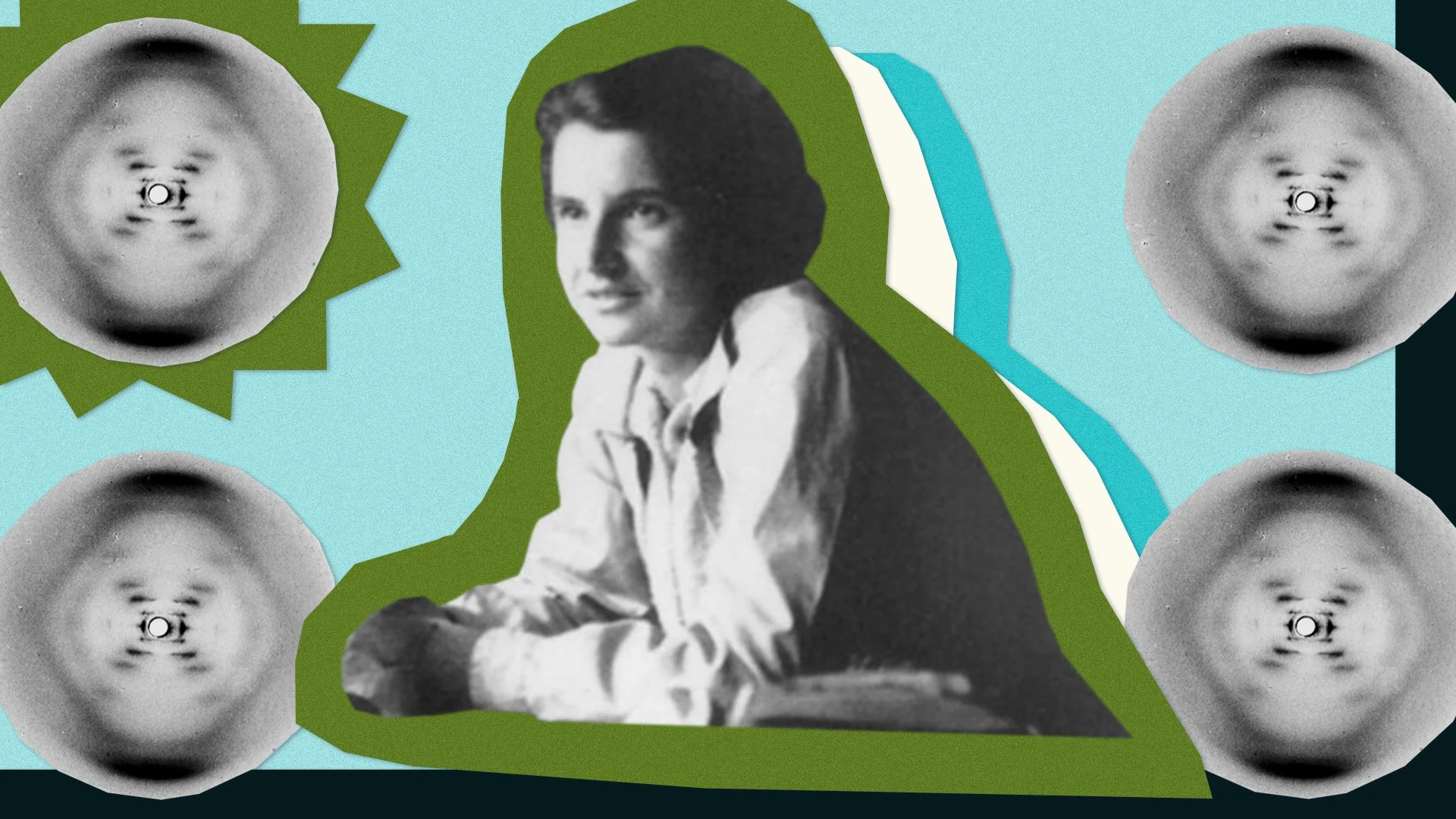
Photo Illustration: Humanizing History Visuals. Photos: CSHL, Bioanthropologist1, CC BY-SA 4.0, via Wikimedia Commons
Welcome to Humanizing History™! Every month, we feature a central theme. Each week, we dive into different areas of focus.
This month’s theme: Behind the Story, Just Outside the Frame
This week’s focus: Hidden History, a facts-based narrative to highlight someone who changed history
Today’s edition of Humanizing History™ is about 1200 words, an estimated 3½-minute read.
The Why for This Week’s Topic
Sometimes a photograph can inspire. Sometimes it can reshape how we understand life.
This is Photo 51.
At first glance, it may not look significant. It’s grainy, black and white, almost abstract. A faint X-shape pattern emerges from blurred lines. It almost looks like a cross section of something mechanical, or something like a spinning record.
But this image was not random. It’s powerful. It was formed by something far too small to see with the human eye. And it took more than 100 hours to capture.
In 1952, this photograph became one of the key pieces of evidence in understanding the structure of DNA — the molecule often described as the “blueprint of life.”
Today, DNA is part of everyday language.
As far as acronyms go, DNA is a famous one. You hear it in biology classrooms, in conversations about ancestry, medicine, and even crime investigations.
Even if the full name — deoxyribonucleic acid — is unfamiliar, the idea is widely known: DNA carries the genetic instructions for how living things grow, function, and reproduce.
You might even recognize its structure: two strands twisting around each other like a flexible, spiraling ladder, a shape known as the “double helix.”
But here’s a part of the story that’s less often asked: How did we come to know this?
In the early 1950s, scientists were “racing to discover” DNA’s structure. Solving it could reshape biology and medicine, and fundamentally change how we understand life itself.
The story is often told through names like James Watson and Francis Crick, whose model of DNA earned a Nobel Prize in 1962.
But behind that breakthrough was an image like the one you just saw. And behind that image was a scientist whose name is less often centered in the story.
Her name was Rosalind Franklin.
And this month, we’re exploring a different kind of changemaker: the people behind the stories we think we already know.
We already examine the contributions of Bayard Rustin and Eleanor Roosevelt.
Now, we’ll explore someone who helped reveal one of the most fundamental structures of life itself.
Who Was Rosalind Franklin?
Rosalind Franklin was a chemist and X-ray crystallographer born in London in 1920.
At a time when relatively few women were encouraged, or had the opportunity, to pursue scientific careers, she studied chemistry at the University of Cambridge and earned a PhD.
Early in her career, she studied the microstructure or porosity of coal, contributing to research that helped improve materials used in gas masks during World War II.
In 1951, she joined King’s College, where she began studying DNA using X-ray crystallography, a technique that uses X-rays to produce patterns that reveal the structures of molecules too small to see directly.
To do this, scientists expose crystallized samples to X-rays, producing "diffraction patterns” that were then analyzed through hundreds of calculations done by hand — long before modern computing technology was available.
Franklin refined this process with exceptional precision. She improved imaging methods, strengthened measurement techniques, and produced some of the most detailed images of DNA at the time. Her work was highly technical, data-driven, and essential to understanding what DNA might look like on a molecular level.
But she also often worked in a scientific environment shaped by hierarchy and exclusion, where women were often left out of informal networks where scientific ideas were exchanged.
And yet, she stayed focused on the data. On the structure. On what the evidence and the days-in-the-making images would reveal.
What She Did, And Why It Mattered
In 1952, Franklin’s lab produced Photo 51.
Without context, it may look like an abstract pattern. To trained scientists at the time, it was a breakthrough.
The X-shaped pattern strongly suggested that DNA had a helical structure.
The image was produced in Franklin’s lab at King’s College London with assistance from graduate student Raymond Gosling, as part of Franklin’s work. Franklin designed the experimental conditions, improved the methodology, and analyzed the data that led to this interpretation. She also carried out extensive calculations to determine key structural dimensions of DNA, including its spacing and symmetry.
At the same time, other scientists were working toward a similar goal. Around this time, Maurice Wilkins, a colleague of Franklin’s at King’s College, shared Photo 51 with James Watson, who worked with Francis Crick to build models of DNA.
Using a combination of evidence — including data derived from Franklin’s lab, such as Photo 51 — Watson and Crick proposed the double helix model in 1953.
Their model became foundational to modern genetics, helping explain how genetic information is stored and replicated. In 1962, Watson, Crick, and Wilkins were awarded the Nobel Prize for this discovery.
Rosalind Franklin was not included.
So Why Don’t We Remember Her Name?
Unfortunately, Franklin died in 1958 at the age of 37, from cancer, four years before the Nobel Prize was awarded. (And Nobel Prizes were not given posthumously.)
But timing alone doesn’t explain her absence from many earlier versions of this story.
Franklin’s work was highly technical and data-driven — the kind of scientific labor that is essential, but often less visible in simplified narratives of discovery.
She also worked in a scientific culture where women were often excluded from recognition and informal decision-making spaces.
Over time, the public storytelling of DNA tended to center a small number of figures rather than the broader network of scientists involved.
Even later accounts, including The Double Helix, a book written by Watson in 1968, shaped public perception of the discovery. Watson’s text referred to Franklin as “belligerent, emotional, and unable to interpret her own data.” Examples like this raise ongoing questions about how scientific history gets written, and from whose perspective.
Today, many historians widely recognize that Franklin’s data, including Photo 51, was essential to understanding DNA’s structure.
Classroom Connection
To bring Rosalind Franklin’s contributions alive in the classroom, start with the image.
Show students Photo 51 without context.
Ask: What do you notice? What do you think this is? What kind of impact do you think this image had?
Reveal the context: “This image is widely considered to have revealed the structure of DNA — the blueprint of life. It was produced by the lab of scientist Rosalind Franklin.”
Consider adding more details, such as its impact. According to biochemist Dr. Maryann Vogelsang, “Solving the crystal structure was what led to our understanding of how DNA is replicated and a significant catalyst for precision medicine today. Rosalind’s X-ray diffraction image was key.”
From there, ask: Why would an image like this matter? How do scientists “see” things that are too small to observe directly? Whose names do you think are often associated with big discoveries, and why? Can you think of any scientists you consider changemakers in the world today?
Let’s Pause and Reflect
If scientific discoveries are built from many people’s work, why do some names become central, while others fade into the background?
How might our understanding of science change if we told fuller or more nuanced stories of how discoveries happen?
And what other stories — in science and beyond — are still sitting just outside the frame?
Sometimes the people who unlock the secrets of the universe are outside of the dominant narrative. Which leaves us with one more question: When we tell the story of discovery, who gets remembered, and who becomes a memorable image?
Theme: