
Meet Eleanor Roosevelt: Behind the Making of Global Human Rights
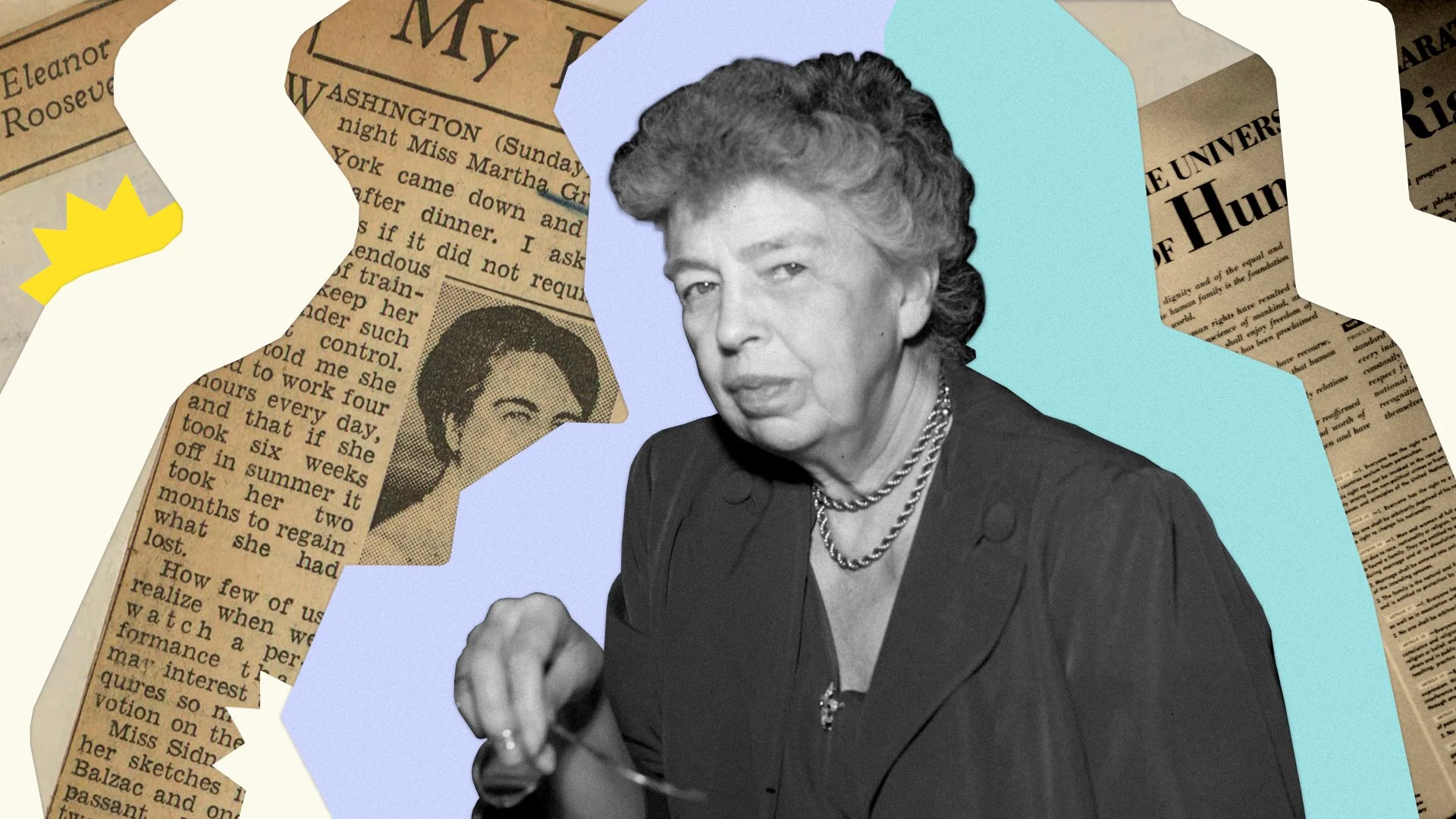
Photo Illustration: Humanizing History Visuals. Photos: Library of Congress, FDR Presidential Library & Museum, CC BY 2.0/Wikimedia Commons
Welcome to Humanizing History™! Every month, we feature a central theme. Each week, we dive into different areas of focus.
This month’s theme: Behind the Story, Just Outside the Frame
This week’s focus: Hidden History, a facts-based narrative to highlight someone who changed history
Today’s edition of Humanizing History™ is about 1300 words, an estimated 4½-minute read.
The Why for This Week’s Topic
The early 20th century was a time of profound upheaval and transformation. World Wars reshaped borders and human life. The Great Depression altered economies and daily survival. In the United States, a president served an unprecedented three terms, and had just begun his fourth when he passed away.
In classrooms, these chapters of history often center familiar figures: Adolf Hitler, Winston Churchill, Franklin D. Roosevelt. Texts and documentaries chronicle the technologies that shaped World War II, such as aircrafts, radar systems, communication networks — much of which laid the groundwork for technologies many use today, like the internet.
Some classrooms examine the contradictions: racially segregated armies fighting for freedom abroad.
And we often learn that, in the aftermath, the United Nations emerged as an effort to reimagine global cooperation and human rights.
Less often, it’s asked: Who helped shape the vision behind those rights?
In the aftermath of World War, a woman chaired the committee responsible for drafting one of the most influential documents in modern history: the Universal Declaration of Human Rights.
Her name was Eleanor Roosevelt.
And this month, we’re exploring a different kind of changemaker: the people behind, or sometimes just beside, the stories we think we already know.
Last week, we covered Bayard Rustin, who organized the March on Washington and much of the Civil Rights Movement from behind the scenes.
Through Eleanor Roosevelt, we’ll explore someone who reshaped norms and operated in full public view and yet whose influence is often only partially told.
Who Was Eleanor Roosevelt?
Eleanor Roosevelt was a writer, speaker, diplomat, and public figure who fundamentally reshaped what it meant to be a “First Lady," and what it means to leverage proximity to power as a platform for human-centered change.
Born in New York City in 1884, into a prominent political family, Eleanor — the niece of President Theodore Roosevelt — had access to social and political networks from an early age. But her childhood was also marked by loss. She was orphaned by the age of ten.
She later attended boarding school in London, an experience that likely helped shape her intellectual curiosity, independence, and, as some biographers suggest, a desire to create a sense of belonging and purpose.
At 19, Eleanor became engaged to Franklin D. Roosevelt, her distant cousin, whom she would marry in 1905. At the time, women in the United States were denied the legal right to vote; the 19th Amendment would not be ratified until 1920.
And yet, Eleanor Roosevelt would go on to become one of the most politically active and publicly engaged First Ladies in U.S. history.
Eleanor Roosevelt transformed and reimagined the role entirely.
The first to hold her own press conferences, Roosevelt created a women-centered press corps, expanding professional opportunities for women in journalism, at a time when they were often excluded from political reporting spaces.
She penned My Day, a near-daily, nationally syndicated newspaper column. Long before the advent of social media, this column created a direct line of communication between Roosevelt and millions of readers. It served as a platform to inform, reflect, and advocate for humanitarian issues.
Roosevelt traveled extensively. She was the first First Lady to fly across the country. She often drove her own car, defying expectations that she be chauffeured. During the Great Depression, she toured the nation, meeting with coal miners in Appalachia and families navigating palpable hardship.
She also visited Japanese American incarceration camps during World War II, where the U.S. government forcibly detained more than 100,000 people — up to two-thirds of whom were U.S. citizens. While working within the context of Executive Order 9066, issued by her husband, President Franklin D. Roosevelt, she nonetheless advocated for the closure of these camps.
In an era of legal segregation under Jim Crow, Roosevelt publicly challenged racial injustice, and urged southern democrats to support anti-lynching legislation. To push for racial integration of the army during World War II, Roosevelt took a highly-publicized flight with Tuskegee pilot C. Alfred "Chief" Anderson, supporting the integration of the armed forces, and essentially marking the “initiation of the U.S. Army's African American pilot program and the activation of the first all-African American military aviation unit.”
At a time when many women were socially and often legally relegated to the background, Eleanor Roosevelt stepped forward — not for visibility alone, but to advocate for civil rights, labor protections, expansive leadership, and human dignity.
What She Did, And Why It Mattered
Eleanor Roosevelt didn’t just participate in history, she helped shape its direction. Working within the system, she helped stretch what it could publicly stand for.
As First Lady, she transformed the position into an active site of engagement, using media, travel, and public presence to document and elevate the lived experiences of everyday people.
But her influence extended far beyond the White House.
After President Roosevelt’s death in 1945, Eleanor Roosevelt was appointed by President Harry S. Truman to serve as a delegate to the newly formed United Nations.
There, she chaired the committee responsible for drafting the Universal Declaration of Human Rights, a document that would articulate a shared global standard for dignity, freedom, and equality for humanity.
Adopted in 1948, the declaration continues to influence international law, policy, and human rights movements today.
Eleanor Roosevelt helped guide this vision into language, structure, and global consciousness. It’s a vision in which race, gender, and other social identities would not determine a person’s access to equality.
Her work reminds us that influence doesn’t always come from holding the highest office. Sometimes, it comes from shaping ideas that guide the actions of nations, like a powerful wind that redirects water’s path.
So Why Don’t We Always Hear Her Name?
Eleanor Roosevelt was widely known in her lifetime. And yet, the full scope of her influence is not always centered in the stories we tell.
Why? Part of the answer may lie in how we define power or influence, and who we expect to hold it.
Roosevelt operated in a role not traditionally associated with policymaking.
She was a woman working within a deeply male-dominated political system.
Much of her influence came through advocacy, media, and cross-racial, gender-expansive coalition-building — forms of leadership that may not have aligned with more traditional definitions of power at that time, but feel strikingly relevant today.
In her time, Roosevelt’s work was visible, but not always framed as central.
And this raises the broader question: Who gets recognized as a primary actor in history — and whose contributions are treated as secondary, even when they are arguably foundational.
Classroom Connection
To bring Eleanor Roosevelt alive in the classroom, consider starting with images or video clips of her in action: meeting with workers, visiting communities, speaking at international gatherings with world leaders, flying with Tuskegee pilots, or driving her own car.
Ask: What do you notice? Who is present? What might be happening in this moment? Does this feel typical for the time period, why or why not?
Introduce Eleanor Roosevelt with a simple framing: “This is someone who helped shape one of the most important human rights documents in modern history.” Expand from there.
To extend: consider reading the text or excerpts from the Universal Declaration of Human Rights; discuss what “human rights” mean in the students’ own lives. Compare her approach to other changemakers students may have studied: Bayard Rustin, Mahatma Gandhi, Malala Yousafzai. The list goes on.
Let’s Pause and Reflect
If history is shaped not only by those elected to lead, but also by those who influence, guide, and redefine leadership itself, how many changemakers have helped build the world we live in, without being fully recognized?
What roles matter in creating change?
Who gets remembered and why?
How might our understanding of history shift if we expand our lens to include those working within, alongside, or just beyond the spotlight?
What might human rights look like today without Eleanor Roosevelt’s influence?
Sometimes the people who reshape the world are not just outside the frame, sometimes they’re standing within it, redefining access and possibility in ways that continue to echo.
Theme: