
How Beavers Shaped Human History
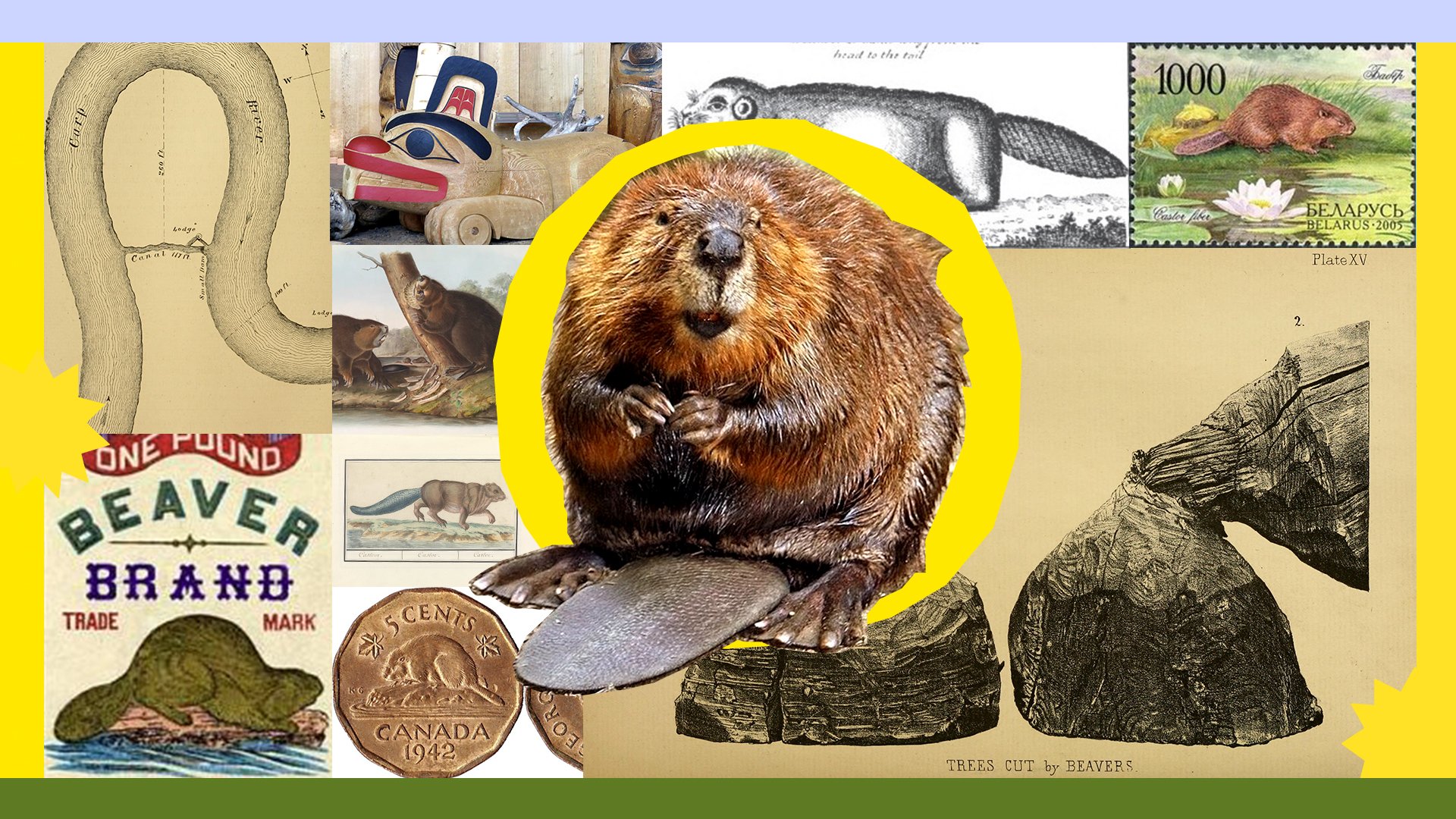
Photo Collage: Humanizing History Visuals. Photos: Morgan, Lewis Henry, Beaver Brand Japan Tea, Louis-Armand de Lom d’Arce, baron de Lahontan, Post of Belarus/Public domain; Awmcphee, Rijksmuseum/CC0; BiblioArchives / LibraryArchives/CC BY 2.0; D. Gordon E. Robertson/CC BY-SA 3.0 via Wikimedia Commons
Welcome to Humanizing History™! Every month, we feature a central theme. Each week, we dive into different areas of focus.
This month’s theme: Animals That Shaped Human History
This week’s focus: Historical Literacy, or helpful frameworks to expand how we approach history and identity
Today’s edition of Humanizing History™ is about 1,400 words, an estimated 5-minute read.
The Why for This Week’s Topic
This month, we’ve been examining animals that — through their relationships with humans — changed the course of human history.
So far, we’ve explored the dog, the horse, and the camel.
For our final week, we turn to the beaver.
If dogs strengthened cooperation, horses transformed speed, and camels expanded endurance, the beaver shaped something quieter, but no less powerful: the land itself.
Beavers are not glamorous or super fast, nor symbols of conquest or empire. And yet, few animals have altered human history — and environments — as profoundly.
The story of the beaver reminds us that the world is not shaped only through domination. Sometimes it’s shaped through patient construction. Sometimes, power flows not from speed or scale, but from the ability to build conditions where life can persist.
And as the climate changes, the beaver’s story is not only connected to our past, but one that might have a great impact on our future.
Beavers, A Keystone Species
Long before humans altered terrain and rivers with concrete and steel, beavers were reshaping waterways with wood, mud, and stone.
A keystone species, beavers have a disproportionately large impact on their environment — their presence can reshape ecosystems, and their absence can trigger cascading ecological loss.
When beavers build dams, they slow water, creating ponds, channels, and expansive wetlands.
These wetlands support fish, birds, amphibians, insects, plants, and mammals. They help retain water during droughts, reduce erosion, and recharge groundwater.
Beavers do not simply live in ecosystems; within balance, they can create the conditions that allow ecosystems to exist and thrive.
Beavers Before Humans, Engineers by Nature
Tens of millions of years ago, evolution sharpened beavers for this role.
Diverse ancient beaver species roamed North America as far back as an estimated 35 million years ago, and made their way into Eurasia. They ranged in size — some as large as a modern-day black bear — and in lifestyle. Some were aquatic, swimming through bodies of water; others terrestrial, burrowing deep tunnels, sometimes in the shape of corkscrews.
Today, two species remain: the North American beaver (Castor canadensis) and the Eurasian beaver (Castor fiber).
Semi-aquatic, modern beavers move between land and water with ease — their webbed feet and paddle-like tails enhance swimming and steering. Like other rodents, their powerful incisor teeth grow continuously, enabling them to gnaw trees, which they use to reconstruct their environments.
Beavers are impressive engineers. Using their bodies as tools, they construct dams — made from logs, packed mud, and boulders — that can reach up to 3 or 4 meters high, and easily stretch to 100 meters long, with the longest known dam extending nearly 800 meters in a Canadian national park. These dams form ponds that expand into complex wetland systems, allowing beavers to access food while remaining safely in water, often just out of reach from predators like bears or mountain lions.
Beavers do not hibernate. Instead, they create year-long lodges — large domes of sticks, mud, and rocks, often 15 feet wide and 6 feet tall. David Attenborough notes that some of these lodges, like one in Wyoming, are so formidable that a bear cannot easily break them down. Lodges include multiple entrances and food storage, allowing them to come and go, as beavers can hold their breath for up to 15 minutes underwater.
Patient and intentional, beavers conduct ongoing maintenance on their dams and lodges, quickly moving into repair the moment they notice a leak.
Harnessed over millions of years, these skills and abilities existed long before humans arrived on the scene.
Beavers and Indigenous Knowledge
For thousands of years, many Indigenous peoples across North America lived alongside beavers, developing deep ecological knowledge of how beavers shaped land and water.
Their presence signaled healthy waterways, abundant fish, fertile soils, and resilient landscapes. In some regions, beaver wetlands supported agriculture and fishing.
In regard to the beaver, ancient traditions in the Americas often honored both balance and spirit — the animals were not overhunted, and their vital role in the ecosystem was recognized as their bones were sometimes returned to the river to “be made again in the water.”
Among the Ojibwe and other nations, beavers appear in stories emphasizing humility, responsibility, and balance with the natural world.
When a Keystone Species Meets a Global Market
A dramatic shift occurred by the late 1600s when beaver pelts became a highly sought-after commodity across Europe — as they were fashioned into near-waterproof felt hats.
Demand skyrocketed, making beaver fur one of the first major exports of the Americas in the era of European colonization.
Vast trade networks formed, connecting Indigenous trappers with European merchants, and colonial outposts to international markets. Cities like Quebec, Montreal, Detroit, and St. Louis grew in part around beaver trading posts. As scale increased, colonial expansion pushed westward, into the Ohio Valley, Great Plains, and Pacific Northwest. Wars broke out.
By the mid-1800s, the beaver population was decimated — what was once hundreds of millions dropped to near extinction in both North America and Eurasia.
Without beavers, wetlands drained. Remember, beavers are a keystone species. Without them — and in combination with further human land modification — it can be argued that rivers flowed faster, cut deeper channels, and lost buffering wetlands that once stabilized water systems. Biodiversity declined.
The great loss of the beaver population was not just the disappearance of an animal, but the collapse of a living, breathing system of land and water: a loss of balanced Earth.
Absence, Then Return
Through trapping regulations and relocation efforts, the beaver population slowly recovered — hovering around 10 to 15 million today.
While some view beavers as pests or vermin, perspectives are shifting.
Scientists, land managers, and Indigenous communities increasingly recognize beavers as powerful environmental allies — especially in a climate-variable world.
Beaver-created wetlands contribute to carbon storage, support biodiversity, retain water during droughts, cool water for fish like salmon and trout, refuel vegetation, and even reduce the spread of wildfires by creating natural fire breaks. With this in mind, many communities are carefully reintroducing beavers to local environments.
In California’s Sierra Nevada mountains, the Tule River Tribe reintroduced beavers to ancestral lands where they had long been eradicated. Through beavers, they aim to restore wetlands, improve water quality, support fish populations, and help protect forests from catastrophic fires.
Charlton Bonham, Director of the California Department of Fish and Wildlife, spoke about the interconnected relationship among beavers and humans and the benefits they bring to the environment: “[It’s] the idea that we can make our future different than our past. Our past is one where we treated these animals, beavers and others, as varmints. And our culture over time ran them off the landscape. That can't be our future.”
Beavers do not replace human infrastructure. Instead, they offer something we ourselves alone cannot reproduce: natural flexibility, self-maintenance, and a wisdom shaped over millions of years of evolution.
They are not machines, they are living collaborators.
Restoring the beaver population is not just nostalgia, it’s tethered to mutual survival. It’s an animal that we may continue to rely on as we navigate the future.
Shaping History and Future, Together
In earlier newsletters this month, we explored animals that enabled empires — expanding human movement, trade, and power.
The beaver represents a shift.
Beavers show us that shaping our world isn’t just about how fast we move, or how far we expand.
It’s also about how we manage water, care for land, and create conditions for life to endure.
Sometimes the future isn’t invented; sometimes it’s restored.
As climate uncertainty grows, the beaver offers a different model of intelligence — one rooted in patience, cooperation, and long-term thinking.
Not domination of nature, but participation within it.
Let’s Pause and Reflect
What does it mean to collaborate with animals in shaping our shared future?
Where might non-human intelligence help address challenges humans have struggled to solve alone?
What would it look like to design with nature, rather than against it?
This month, we’ve seen how animals have shaped our human story — through cooperation, expansion, endurance, and engineering.
Together, their stories remind us that humans have never shaped the world alone.
And our future may depend on remembering that.
Theme: