
How Camels Shaped Human History
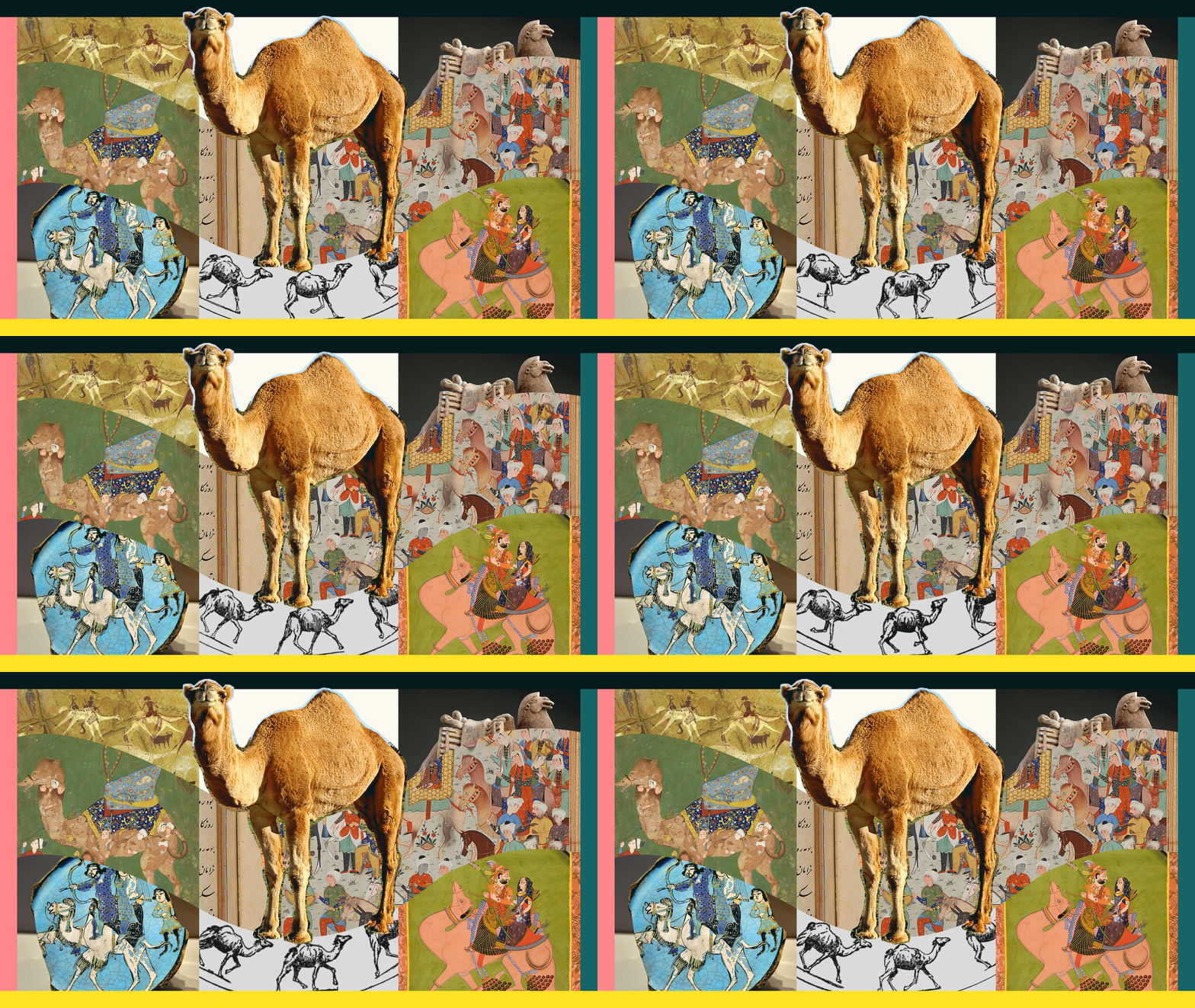
Photo Collage: Humanizing History Visuals. Photos: Eadweard Muybridge, Aga Khan Museum/Public domain; Metropolitan Museum of Art, CC0; Osama Shukir Muhammed Amin FRCP(Glasg)/CC BY-SA 4.0, David Stanley from Nanaimo, Canada/CC BY 2.0, Jjron/CC BY-SA 3.0, via Wikimedia Commons
Welcome to Humanizing History™! Every month, we feature a central theme. Each week, we dive into different areas of focus.
This month’s theme: Animals That Shaped Human History
This week’s focus: Historical Literacy, or helpful frameworks to expand how we approach history and identity
Today’s edition of Humanizing History™ is under 1200 words, an estimated 4-minute read.
The Why for This Week’s Topic
This month, we’re examining animals that — through their relationships with humans — changed the course of human history.
So far, we’ve examined the dog and the horse.
This week, we turn to the camel.
If horses compressed time and space across grasslands, camels accomplished a similar feat across deserts.
They transformed environments often described as empty, barren, or uninhabitable into corridors of movement, exchange, and connection.
Camels didn’t just survive extreme environments — they enabled civilizations, trade networks, and cultures to flourish where humans alone were less capable. From nomadic lifeways to imperial ambition, camels reshaped how people moved, traded, worshipped, and built power across arid lands.
Together, humans and camels didn’t just cross deserts. They transformed them from barriers into bridges.
Camels Long Ago, Remarkable Adaptation
Camels are marvels of evolution.
With wide, padded feet that prevent sinking into the sand; long eyelashes and three eyelids to protect against blowing dust; nostrils that can close during sandstorms; and humps that store fat — not water — camels are built for endurance in extreme conditions.
Designed to conserve energy, their bodies can tolerate levels of dehydration that would be fatal to most mammals, and they regulate body temperature by allowing it to fluctuate, reducing the need for constant sweating in intense heat.
There are two species most central to human history: the dromedary, also called the Arabian camel, with a single hump, common across North Africa and the Middle East; and the Bactrian camel, with two humps, native to Central Asia.
Despite being referred to as “ships of the desert,” camels did not begin in deserts — or even in AfroEurasia.
Fossil evidence shows camel ancestors first evolved in North America around 40 million years ago, when the continent was far wetter and more forested.
Over millions of years, as climates shifted and grasslands expanded during the Miocene epoch, camels diversified, developing longer legs and more efficient bodies suited for open terrain.
It’s estimated that by about 6 million years ago, some camel populations crossed the Bering land bridge into Eurasia. Camels later disappeared from North America around 10–12,000 years ago, during the last Ice Age.
Archaeological evidence also suggests that camels, long ago, likely survived in cold, arctic environments.
This long evolutionary history demonstrates remarkable adaptability and survival long before humans entered the picture. It also reinforces an important point: camels were not shaped for humans. Humans learned to live with animals that had already mastered extremes.
By the time humans encountered camels in Eurasia and Africa, these animals were already specialists in endurance.
Why Camels and Humans? The Endurance Factor
If dogs strengthened cooperation and horses transformed speed, camels transformed human possibility through endurance.
For much of human history, deserts created formidable limits. Vast distances, scarce water, extreme temperatures and limited shelter made sustained travel dangerous and unpredictable. Human movement alone could rarely support large-scale trade or long-distance exchange across these environments.
Camels changed that equation.
They could carry heavy loads for days without water, travel reliably across sand and stone, and recover quickly when resources reappeared. Their oval-shaped red blood cells allow blood to continue flowing even during extreme dehydration, and camels can drink large quantities of water in a single sitting — more than a few dozen gallons of water at a time. They can also eat cacti whole, including the spines.
Their endurance and adaptability made consistent transport possible in an ancient desert ecosystem.
In partnership with camels, humans could navigate worlds that were once isolated. Endurance — not speed — became the critical technology.
Once humans learned to rely on camels’ endurance at scale, deserts no longer marked the edges of human worlds, they emerged as connective tissue.
Domestication and Desert Networks
Camels were domesticated around 3,000 to 4,000 years ago, likely in multiple regions. The impact was swift and far-reaching.
Domestication transformed camels into mobile infrastructure. Where roads, rivers, and wheeled carts failed, camels succeeded. They carried people, water, food, textiles, meals, and ideas across terrain that had long resisted sustained human travel. Caravans of hundreds — sometimes thousands — of camels stitched together regions once separated by environmental danger and distance.
Camels played a central role along portions of the Silk Road, connecting East Asia, South Asia, the Middle East, and Europe. In addition to silk and spices, technologies, languages, scientific knowledge, and religious beliefs traveled along these interconnected paths.
Across North Africa and the Middle East, camel caravans — peaking around 1200 to 1450 CE — enabled trade across the Sahara, the largest hot desert on Earth. Goods like gold, salt, and ivory fueled powerful states, including Ghana and Mali.
One of the most striking examples of camel-enabled power is the Mali Empire, led by 14th-century ruler Mansa Musa, who is often cited as one of the “wealthiest people in history.” His pilgrimage to Mecca reportedly involved tens of thousands of attendants and “80 camels, each carrying 300 pounds of gold.”
Camels were not simply animals for transport. They were the quiet engines of long-distance trade, empire, and early globalization as they transformed deserts into active centers of exchange.
Humans Introduce Camels to New Regions
As empires expanded, humans attempted to introduce camels to new environments — sometimes successfully, sometimes recklessly.
In Australia, camels were imported in the 19th century by British colonists. Once motorized vehicles were available, many camels were released, forming a feral population. As a result, more than one million feral camels continue to roam the continent.
In the southwestern United States, camels were briefly introduced by the U.S. Army in the mid-1800s to support transport across desert terrain. The experiment was short-lived, abandoned after the Civil War, and the camels were sold at auction.
Such examples reveal a recurring tension in human history: whether animals are treated as expendable tools, or as partners requiring knowledge, respect, and responsibility.
Camels Today, and Tomorrow
Today, camels remain central to life in many regions across the world, as they provide food, transport, and economic security.
As climate change intensifies droughts and extreme heat, camels are increasingly viewed not only as animals of the past, but as part of the future. Their resilience may offer lessons for food security, sustainable agriculture, and survival in warming environments.
At the same time, ethical questions persist about labor, conservation, and care (consider this story of a small community of herdspeople who have taken care of the Kharai, a rare kind of swimming camel in India, for generations).
Camels remind us that adaptation alone is not enough. How humans choose to partner with animals also matters.
Let’s Pause and Reflect
How does endurance shape power differently than speed?
What might world history have looked differently if camels had never been domesticated?
What does our relationship with animals teach us responsibility, care, and survival?
Next week, we’ll conclude our exploration with the beaver — an animal that shaped not empires, but ecosystems, and may offer clues for how humans can live more sustainability in the future.
Theme: