
How Horses Shaped Human History
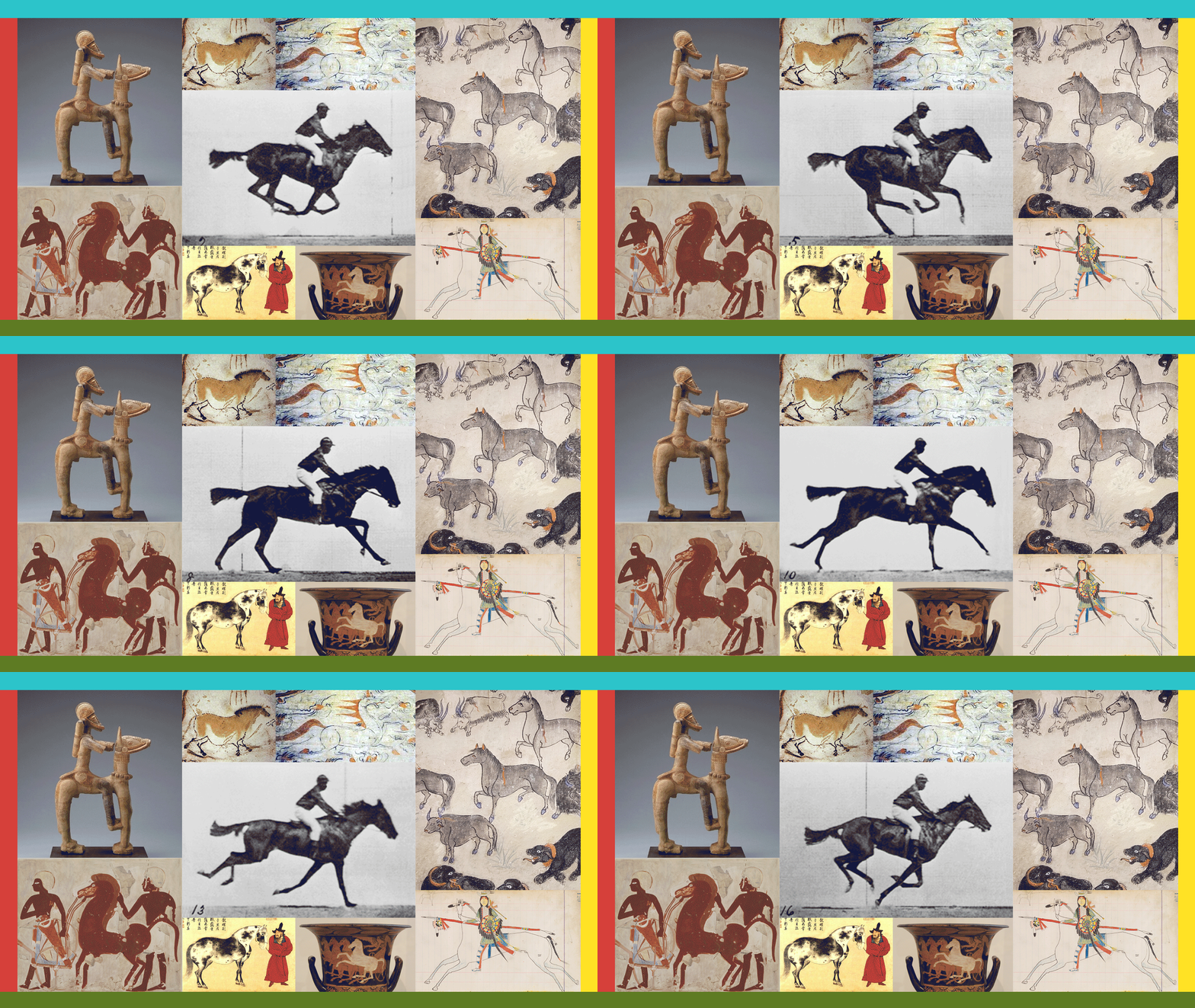
Photo Collage: Humanizing History Visuals. Photos: Zhao Yong, Franko Khoury, Lascaux, Eadweard Muybridge/Public domain, Bernard Gagnon, Gary Todd from Xinzheng, China, Metropolitan Museum of Art, Charles Wilkinson/CC0, via Wikimedia Commons.
Welcome to Humanizing History™! Every month, we feature a central theme. Each week, we dive into different areas of focus.
This month’s theme: Animals That Shaped Human History
This week’s focus: Historical Literacy, or helpful frameworks to expand how we approach history and identity
Today’s edition of Humanizing History™ is about 1300 words, an estimated 4½-minute read.
Trigger Warning: This newsletter references colonization and violence. Please care for yourself as needed.
The Why for This Week’s Topic
This month, we’re examining animals that — through their relationships with humans — changed the course of human history.
Last week, we began with the dog, an early companion shaped by mutual survival, cooperation, and care.
This week, we turn to the horse.
Strong, agile, and fast, horses transformed how far people could travel, how quickly ideas and goods could move, and how power could expand across large swaths of land.
They reshaped trade routes, warfare, migration, and even empire — often with profound consequences for humans, some unfortunately catastrophic.
The story of the horse is not only one of partnership, but also domination, extraction, and scale. It’s a story marked by innovation and violence, connection and collapse.
To understand how horses shaped human history is to confront how animals can amplify human ambition — and how power rarely has a neutral impact.
Together, humans and horses created a complex legacy: one that changed the trajectory of world history.
Horses Before Domestication: Present in Human Life
Long before the domestication of horses, humans have depicted them in art — demonstrating attention, admiration, and familiarity that dates back to tens of thousands of years.
Some of the oldest known visual depictions of horses appear in the Chauvet-Pont-d'Arc Cave in present-day France, created more than 30,000 years ago. These remarkably detailed drawings – some made with charcoal, likely from burnt pine — place horses alongside other animals that shared the Ice Age landscape with humans.
Less than two inches wide, carved from ivory, and about 35,000 years old, the oldest known three-dimensional sculpture of a horse was unearthed at the Vogelherd site in present-day Germany.
Long before humans rode or domesticated horses, they observed them, imagined them, and rendered them with care — indicating cultural significance. These artworks suggest an important truth: horses existed independently of human control for millennia.
Today, the Mongolian wild horse, or Przewalski’s horse, is often considered to be the last truly “wild” horse — a species that was never domesticated, with a unique genetic profile distinct from modern horses. Most horses seen roaming freely today across plains or hillsides are feral, not wild, meaning they descend from domesticated horses that escaped or were released by humans.
This distinction matters, reminding us that even landscapes that appear “natural” are often deeply shaped by humans.
Yet, it would take tens of thousands of years for humans to harness and redirect the horse’s path.
The Genetic Bottleneck Theory: One Lineage Replaced Many
The origins of the modern horse (Equus ferus caballus) have long been debated. For years, researchers questioned whether horses were domesticated in a single region or independently across multiple areas.
To investigate, scientists turned not only to art and archaeology, but increasingly to genetics. In 2021, an international team of more than 160 researchers sequenced the genomes of 273 ancient horses from across Eurasia. Their findings led to a striking pattern: until about 4,000 years ago, horses were genetically diverse across vast regions. Then, quite suddenly, in an explosive time frame of just centuries, one lineage seemingly replaced many of the others.
This lineage carried two key gene changes — one associated with spinal development and another with mood regulation — making these horses more suitable for carrying heavy loads and interacting with humans.
Likely originating on the grassy Eurasian steppe near today’s Volga and Don Rivers in present-day Russia, this population became the assumed ancestor of modern domestic horses.
This shift was not the result of “natural superiority.” Instead, it reflects a moment of convergence — where geography, selective breeding, and human ambition aligned.
Modern horses are the product of that moment, shaped not just by biology, but also by human hand.
Why Horses and Humans? The Speed Factor
Where dogs strengthened cooperation and survival, horses transformed scale by compressing time and space.
Horses allowed humans to travel farther in days than had previously been possible in weeks — carrying goods and communication across continents, and waging war and territorial expansion with unprecedented speed.
For example, as part of the Persian Royal Road, an intricate road system built in ancient Persia, relay riders on horseback could carry messages more than 200 kilometers in a single day, transforming communication into an institutional pillar of imperial expansion.
Humans also innovated technologies in connection to the horse — developing chariots and cavalry that changed the ways battles were fought.
Additionally, the invention of saddles improved stability and endurance, while later innovations, such as stirrups, allowed riders to stand, balance, and wield weapons more effectively.
The Mongol Empire, for example, rose on horseback. Horses were central to Mongol society, in fact, some claim that “Without the horse, there would have been no Mongol Empire.” A nomadic culture, Mongol society relied on the horse for military strength, rapid communication, sustenance, and symbols of wealth and identity, and companionship. Both women and men rode horses and managed herds — a tradition that continues across Mongolia today.
Horses allowed the Mongol Empire to expand across more territory in a few decades than most empires could in centuries, helping it become one of the largest contiguous empires in world history.
Before steam engines, railways, and automobiles, horses — and the innovations built around them — were among the most powerful technologies and forces humans had ever known.
Horses and European Colonization
Unlike Eurasia and North Africa — where horses had been successfully domesticated for thousands of years — horses were absent in the Americas for millennia.
The absence traces back to the late Ice Age, when waves of megafauna extinctions swept across the Americas between roughly 13,000 and 10,000 years ago. Large animals such as woolly mammoths, giant ground sloths, and even horses disappeared. While the precise causes remain debated, the timing coincides with significant climate shifts and human arrival.
Whatever the combination of causes, the result was clear: for thousands of years, societies across the Americas developed without horses.
The next time horses returned to the Americas, it was in the 16th century, alongside Spanish colonizers. Combined with the unfamiliar weapons and devastating diseases carried by colonizers, horses amplified their military power in ways that were extraordinarily difficult to counter, contributing to the fall of the Inca Empire.
Yet, this story is not simply one of conquest. It underscores how geography, access to animals, and natural resources shape power — and how land shapes people and people shape land.
After the arrival of the horse, Indigenous peoples across the Americas quickly adopted and integrated horses into their own lifeways. From there, horses transformed hunting, trade, warfare, and mobility, particularly among Plains cultures, becoming deeply embedded in social and cultural identities.
Once horses entered a society, they reshaped it — but not always by choice, and sometimes through cycles of destruction, adaptation, and renewal.
Horses Today
As technologies changed, the human relationship with horses also evolved.
With the rise of industrial machinery, steam engines, and automobiles, horses gradually declined as a primary source of labor and transportation, though they continue to serve in some societies as transportation, sport, or work animals.
Ethical questions around the use of horses remain, from sport and tourism to horse-drawn carriages in cities like New York. These conversations reflect a broader reckoning with how humans use — and our responsibility toward — the animals that once powered ambition and empire.
Even today, horses remain steadfast symbols of freedom, strength, and movement, carrying the weight of a long and complicated shared history.
Without horses, chapters of human history might not simply have unfolded more slowly — they might have risen and fallen in entirely different ways.
Let’s Pause and Reflect
What might our world look like today if humans had never domesticated horses?
How did human interaction with horses shape movement, empire, and power?
On a personal level, what does your relationship with animals teach you about power, responsibility, and care?
Next week, we continue our exploration with the camel, a remarkable animal whose endurance reshaped life across some of the most challenging landscapes on Earth.
Theme: