
How Dogs Shaped Human History
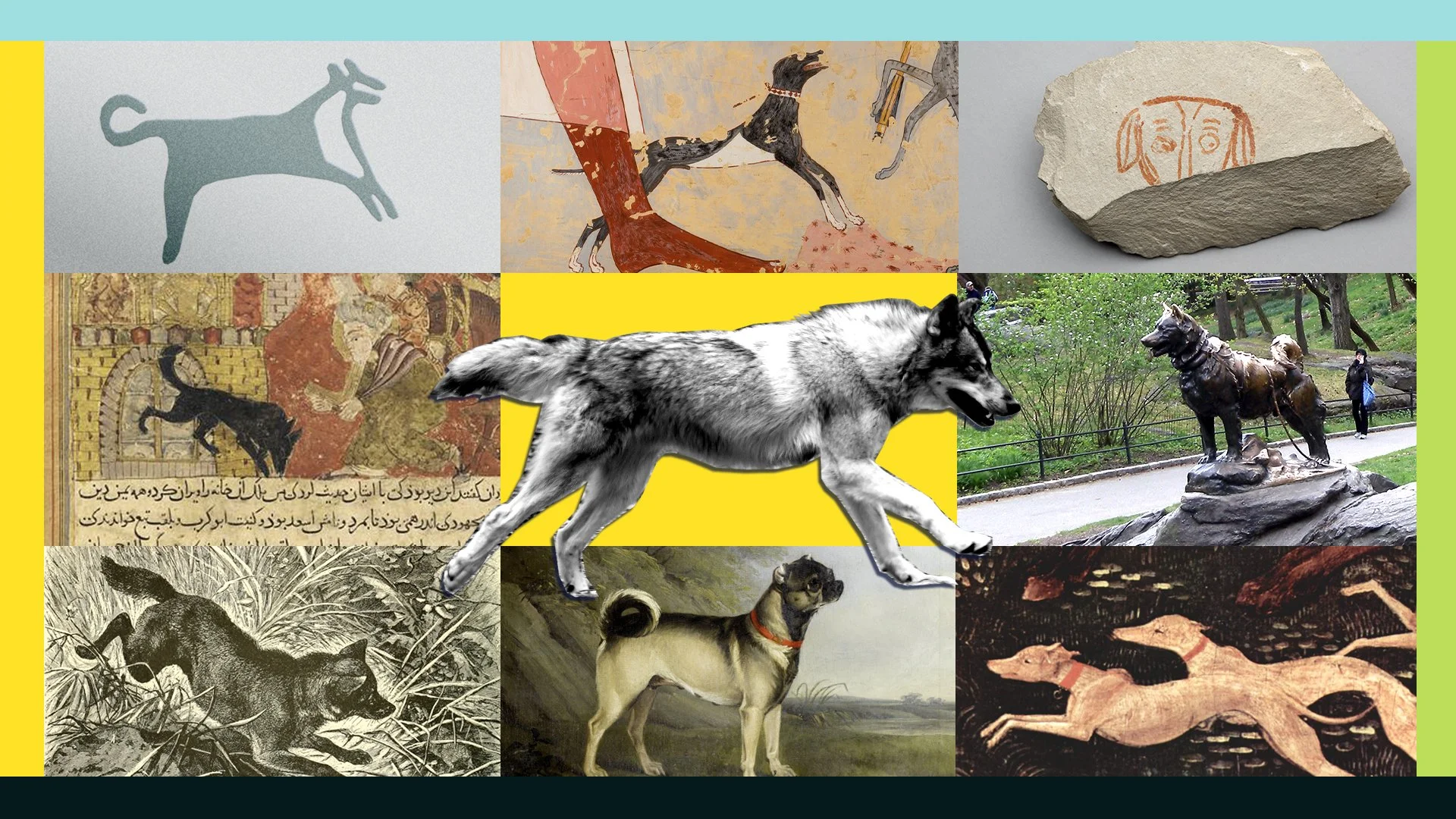
Photo Collage: Humanizing History Visuals. Photos: Jim.henderson, Abu Ali Bal'ami, Henry Bernard Chalon, Paolo Uccello, Internet Archive Book Images/public domain; Nina M. Davies, Metropolitan Museum of Art/CC0; Brendan J. O'Reilly/CC BY-SA 4.0 via Wikimedia Commons
Welcome to Humanizing History™! Every month, we feature a central theme. Each week, we dive into different areas of focus.
This month’s theme: Animals That Shaped Human History
This week’s focus: Historical Literacy, or helpful frameworks to expand how we approach history and identity
Today’s edition of Humanizing History™ is about 1,200 words, an estimated 4½-minute read.
The Why for This Week’s Topic
This month, we’re inspired by the horse — the next cycle of the Chinese lunar zodiac. While the Year of the Horse in the Gregorian calendar doesn’t arrive until February, thinking about the horse — and the impact horses had on the course of human history — led us to reflect more broadly on humans and the relationships they have with other animals (humans are animals too!).
Across time and place, animals have held special significance to humans: as companions, workers, protectors, and even collaborators in survival.
From inspiring storytelling and symbolism to serving as friends and foes, it’s nearly impossible to imagine human existence without animals. They’ve shaped us, and we’ve shaped them — sometimes to our detriment, sometimes to our surprise, and sometimes in ways that brought unexpected benefits.
This month, we’re exploring animals that, through their relationships with humans, changed the course of human history — animals whose stories are anchored in our past, present, and future.
We’ll begin with one of our oldest companions, the first animal humans domesticated: the dog.
Where Did Dogs Come From?
Humans and dogs share a story that spans tens of thousands of years.
Before humans built known cities, writing systems, or agriculture, they built fires, social networks, and survival strategies — and in the process, they formed a bond with wolves that would eventually produce the domestic dog.
Dogs belong to the species Canis lupus familiaris, domesticated from gray wolves (Canis lupus). Evidence suggests that humans and wolves began interacting closely somewhere between 20,000-40,000 years ago — though when and where domestication first occurred remains debated.
Some research indicates that dogs may have been domesticated independently in multiple regions, including East Asia and Western Eurasia, producing lineages that later spread across the globe.
Tens of thousands of years ago, parts of Eurasia, including Siberia, were frigid but hospitable to humans. Rich with game — including Ice Age "megafauna" such as wooly mammoths and wooly rhinoceroses — these regions offered opportunities for close wolf-human interaction.
Archaeological excavations along the Yana River in Siberia have uncovered “axes, stone scrapers, worked quartz crystals, tools made from wolf bone and spear foreshafts made from mammoth ivory and woolly rhinoceros horn.” Such findings suggest humans lived alongside animals in highly strategic and interconnected ways.
Tamer wolves likely lingered near human camps, perhaps drawn by food scraps. Over generations, some of these wolves transitioned from tolerance to companionship, and eventually, to domestication.
A striking example is Dogor, an 18-20,000-year-old puppy found in Siberia’s thawing permafrost in 2018. Dogor’s near-complete body — including fur, paws, a snout, and even tiny teeth still intact — represents a creature that is neither fully wolf nor fully dog. A proto-dog, Dogor bridges the space between wild and domesticated forms.
There is even evidence that perhaps around 15,000 years ago, dogs “accompanied the first people into the Americas,” crossing Beringia — a “huge tundra landscape, bounded by the stocky shoulders of two continents and stretching more than one thousand miles from north to south.” Shaped by extreme cold and limited resources, the tundra raises an intriguing question: Would dogs have entered the Americas without humans — and humans without dogs?
Both species were shaped by this long, complex relationship, intertwined with migration, survival, and adaptation.
Why Dogs and Humans?
The bond between humans and dogs was mutually transformative.
Wolves’ social instincts, such as alerting others to danger and coordinating group behavior, were invaluable to humans. Accustomed to complex social systems, domesticated dogs could also strengthen social cohesion within human groups.
Dogs were remarkably versatile: they helped humans hunt, track, and flush animals from burrows; haul and transport supplies across frozen terrain; guard camps and livestock; herd flocks; and even manage waste by consuming scraps that might otherwise attract vermin. And, of course, they offered companionship, including powerful bonds in often isolated environments.
In return, humans offered food, shelter, and another form of protection. This partnership allowed both species to thrive in challenging environments, from the Siberian tundra and beyond. In some cases, it may have meant the difference between life and death.
Some researchers have even speculated that dog domestication may have contributed to Homo sapiens’ success over Neanderthals.
Clearly, humans and dogs made — and continue to make — a formidable team.
Dogs Around the World
Today, dogs are found nearly everywhere humans live on Earth.
Across time and place, humans have selectively bred dogs for size, strength, speed, temperament, and skill — creating an extraordinary range of forms and abilities.
Long ago, across Europe and Asia, dogs were often used as hunting companions. In the Arctic, they were trained to pull sleds, transporting people, medicine, and supplies across frozen landscapes. Across Africa and Europe, dogs played vital roles in herding and protecting livestock. In the Pacific Islands, dogs accompanied maritime voyages and were cherished companions.
We can also attempt to measure the importance of dogs through how humans honored them in death — or through intentional burials.
In Siberia, dogs have been excavated in ancient cemeteries, thousands of years old, some buried with decorative collars and special items, such as spoons carved from antler. In Egypt, mummified dogs — “carefully wrapped in linen and buried with great care” — have been found, including in the Valley of the Kings. In the Americas, dogs were often buried alongside humans, sometimes positioned side by side, in what appears to be a sleeping posture.
Dogs also appear in early art. In present-day Iran, 8,000-year-old pottery features some of the oldest known depictions of dogs. Archaeologists Hole and Wyllie describe these images: “At a time when naturalist pictures of any kind were rare on pottery, dogs were painted on [these] vessels… closely resembling the ubiquitous guard dogs seen in villages and camps today, a form and size not too far removed from wolves.”
Across continents and eras, dogs adapted alongside humans — proving themselves indispensable in survival, work, and culture.
The “Modern” Dog
Over time, dogs shifted from purely practical roles to also include aesthetic and cultural ones.
The Victorian era’s dog shows shifted the emphasis from utility to appearance, leading to the emergence of many modern breeds.
Today, dogs continue to serve humans in countless ways: as guide and therapy dogs, as working dogs for search-and-rescue, as cultural fixtures, appearing in art, literature, film, and everyday life.
And humans continue to canonize dogs — from Balto, whose statue stands in Central Park commemorating his role in delivering life-saving medicine during an Arctic epidemic, to Hachikō in Japan, who faithfully waited for his owner at a train station every day, even after his owner’s death.
Whether living in forests, cities, or anywhere in between, humans remain connected to dogs — practically and emotionally.
This enduring partnership shaped human culture, health, and daily life.
Without dogs, early humans may have faced far greater challenges in survival, and our species’ history may have followed a very different path.
Let’s Pause and Reflect
How did our ancestors' interaction with dogs shape human survival and community?
What might our world look like today if humans had never partnered with dogs?
On a personal level, what does your relationship with animals teach you about humans, community, and care?
Next week, we continue our exploration with another remarkable animal: the horse, whose strength, speed, and relationship with humans transformed travel, trade, and empires — leaving a complex legacy.
Theme: