
Living with Water Extremes: Innovations from Ancient Civilizations to Today
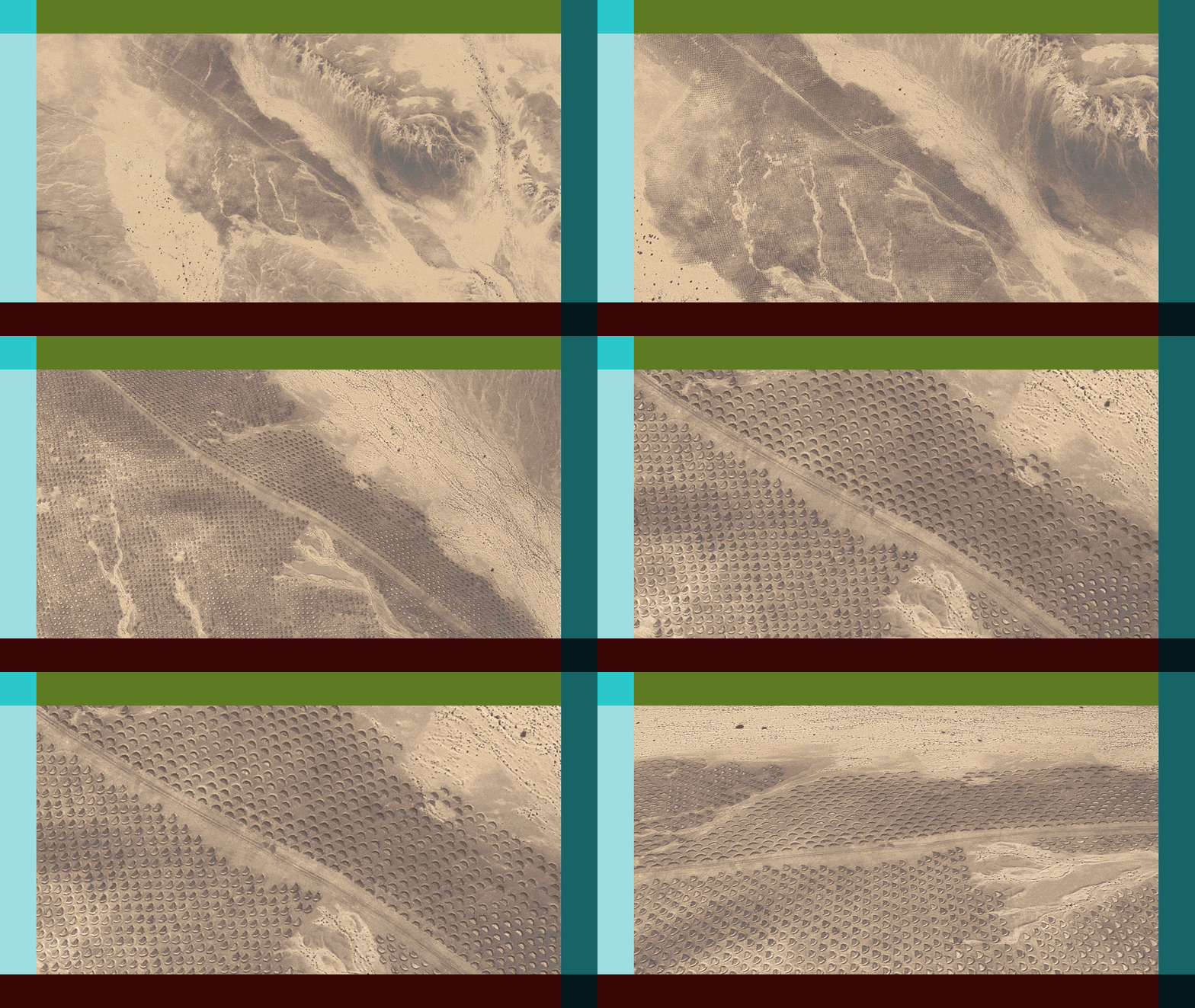
Photo Illustration: Humanizing History Visuals. Maps Data: Google, Airbus, Landsat / Copernicuss
Welcome to Humanizing History™! Every month, we feature a central theme. Each week, we dive into different areas of focus.
This month’s theme: How Water Shapes People and People Shape Water
This week’s focus: Hidden History, a facts-based resource to highlight technological and cultural innovation
Today’s edition of Humanizing History™ is about 1100 words, an estimated 4-minute read.
The Why for This Week’s Topic
Imagine standing in the middle of parched terrain after months of no rain. The ground is thirsty. Crops struggle to grow. Now imagine that, days later, the skies open. Rain falls fast. Rivers swell. Water rushes toward homes, fields, and roads.
Water gives life, but it can also unfortunately take it away.
Across time and place, humans have lived with this duality.
Too little water can threaten survival. Too much can also reshape lives and landscapes.
As a result, communities have learned to adapt to extremes, like droughts and floods. Throughout human history, ingenuity, observation, and cultural knowledge have helped many navigate scarcity and abundance.
Some of these lessons remain relevant today, especially for our climate-variable world.
This month, we’ve explored how water shaped people and how people shaped water.
In Week 1, we reviewed how people learned to find water where none seemed to exist, at least on the surface.
In Week 2, we examined how engineers moved water across vast distances to sustain growing cities.
In Week 3, we highlighted how humans have honored water as something living or sacred.
This week, we turn to resilience, or the ways communities — past and present — navigate water as both a destructive power and a life-giving necessity.
Lessons From the Sahel, A Case Study in Adaptation
Stretching along the southern edge of the Sahara Desert, and hugging the northern reaches of the greener, humid savannahs, the Sahel is a vast “transition zone,” in Africa.
Derived from the Arabic word for “coast” or “shore,” the Sahel spans numerous countries including Mali, Senegal, Nigeria, Chad, Sudan, Eritrea, and more.
A largely flat region with occasional highlands, the Sahel is home to grasslands dotted with hardy vegetation like acacia trees and thorny jujubes. It’s a place of high temperatures, seasonal winds, and a climate shaped by variability.
Thousands of years ago, the Sahel was far more humid, with rivers and lakes scattered across the landscape. Over time, it became increasingly shaped by cycles of drought and rainfall, which were at times unpredictable and extreme.
Living in the Sahel has required adaptation.
Across generations, Sahelian societies developed strategies to work with water’s uncertainty.
Long ago, during the dry seasons, ancient farmers of the Sahel utilized the Zai technique. They would dig small pits in the ground and fill them with organic matter to attract termites. Termites would then burrow deeper channels, like natural pipes, so when the first rains fell, it could better reach subsoil.
Building upon this innovation, generations later, agriculturalists created "stone lines,” or curved dikes, by laying stones along the contours of land to capture rainwater.
Eventually, engineers of the Sahel developed an even more complex, striking innovation: half-moon fields. They carved shallow, curved basins, like vessels, about 4 meters in diameter, into the land along natural contours. When rain falls, the half-moon vessel slows and captures runoff, allowing water to soak into the otherwise dry soil and sustain crops long after the rain has passed. From above, these fields can resemble a series of crescent oases, scattered across dry terrain.
These innovations are not only technical, they are intentional, generational. They reflect close observation of land, weather, time, and cultural knowledge.
Water, in many Sahelian cultures, is more than functional. It is also tied to belief, story, and meaning.
Across the region — and throughout much of the African continent — water is often understood as something living: an oracle, a keeper of memory, a force that “holds the past while shaping the present." In this way, water is not separate from human life, but deeply intertwined with it.
In Mali, the Dogon have a creation story centered on Water Spirits known as Nummo or Nommo, often described as teachers and guardians of the universe. Reflecting water’s deep connection to life, in Dogon language, the words for water and speech are linked. Rivers and ponds are seen as spiritual portals, or places where the visible and unseen worlds meet. And rainmaking rituals have long been practiced in response to rainfall that is both scarce and essential.
These beliefs reflect a close relationship with an environment where water is not guaranteed, but vital and deeply revered.
Patterns Across Time and Place
Today, the Sahel faces new challenges. Rising temperatures, shifting rainfall patterns, and expanding desertification are reshaping the region once again.
And yet, many of the same principles of survival remain: observe carefully, adapt thoughtfully, and work with the rhythm of water. Develop a relationship with it.
As a farmer from Chad, Hissein Mahamat, shared in this video: “Water is the most precious thing we have. The rain allows our plants to grow. It gives us food. Human beings can’t do anything without food.”
To combat desertification, countries across the Sahel are taking action. One example is the Great Green Wall, an African-led initiative aiming to restore 8,000 kilometers of “degraded land” by planting trees, including acacias, alongside other methods like water harvesting. It’s an act of continental resilience in the face of extremes.
The Sahel is not alone. Across the world, societies have found ways to live with the other extreme: too much water.
In Venice, a city built on water, generations of Venetians developed lagoon-based engineering structures, such as canals, barriers and foundations that were designed to live with rising and shifting tides. Today, those systems are being tested as severe flooding becomes more frequent.
In the present day, new tools continue to emerge. In Hong Kong, for example, the government utilizes the Hong Kong Observatory, a weather predicting system highly regarded for its “nowcasting” capabilities. Using a combination of satellite data and complex algorithms, nowcasting tracks sudden typhoons and extreme rainfall with remarkable precision. This allows people to prepare, find shelter, and respond more quickly to rapidly changing conditions.
Across all of these examples — past and present — a pattern emerges: resilience is not always about controlling water entirely, but about learning to anticipate, adapt, and respond to its movement.
As water changes, so must we.
Let’s Pause and Reflect
Across the month, we examined how water shapes people, and how people shape water. We’ve explored hidden water, moving water, sacred water, and now water in its most unpredictable forms.
As you reflect, consider asking:
What kind of water extremes or events has your community experienced?
How do people where you live prepare for or respond to these events?
What innovations or lessons from ancient or past societies might still apply today?
How might seeing water as something to respect, and not just manage, change our decisions?
From underground wells to aqueducts, from cenotes to half-moon fields, stories from history reveal that water is not just a resource, but can also be a teacher, a connector, and something to build a relationship with.
How we connect to water today may shape the health and resilience of our communities in the future.
Theme: