
Constructing Water Highways: Innovations from Ancient Civilizations
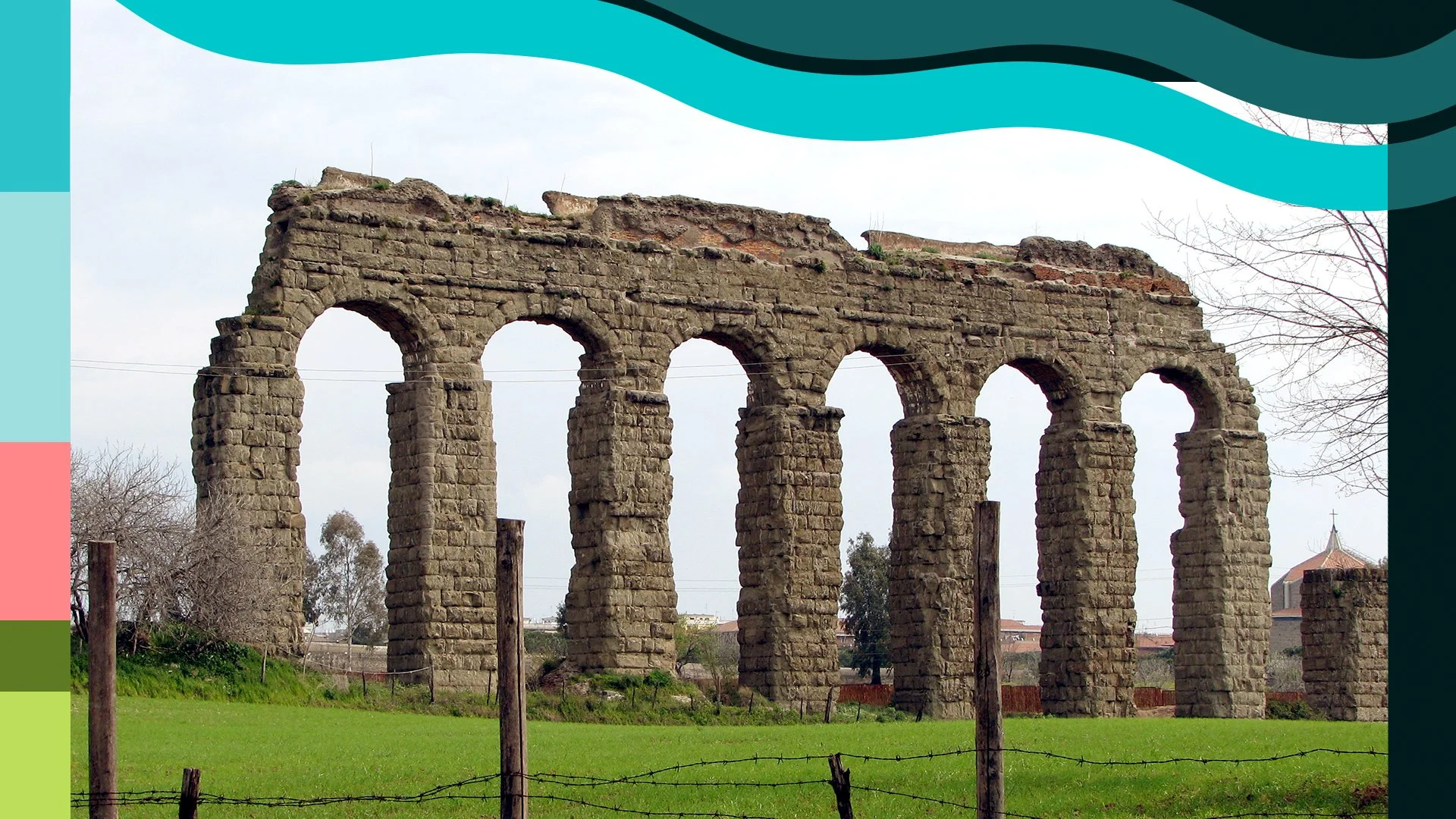
Photo Illustration: Humanizing History Visuals. Photo: Chris 73, CC BY-SA 3.0, via Wikimedia Commons
Welcome to Humanizing History™! Every month, we feature a central theme. Each week, we dive into different areas of focus.
This month’s theme: How Water Shapes People and People Shape Water
This week’s focus: Hidden History, a facts-based resource to highlight technological and cultural innovation
Today’s edition of Humanizing History™ is about 1300 words, an estimated 4½-minute read.
The Why for This Week’s Topic
Imagine a city coming to life at dawn. Vendors set up their stalls as animals are led through crowded streets. Families begin their daily routines, preparing food, washing clothes, and collecting water for the day ahead. Outside the city center, farmers prepare their fields and tend thirsty crops.
Now imagine that the nearest reliable water source lies miles, or kilometers, away. There are no electric pumps. No treatment plants. No modern pipes or monitoring systems controlling the flow of water as many cities have today.
So how did ancient cities get the water they needed?
In ancient Rome more than 2,000 years ago, public baths were central to daily life. Water splashed into stone pools as bronze horns sounded, and donkeys and mules pulled carts through crowded markets.
About 1,500 years later and across the world, Inca cities thrived high in the Andes. Spring water flowed through a sequence of carved stone fountains as alpacas grazed on nearby terraces and conch shells and drums echoed across mountain landscapes.
Both civilizations relied on something remarkable: carefully designed systems that transported water across vast distances — long before electricity and other modern forms of technology existed.
This month, we’re examining how water shaped people, and how people shaped water.
Last week, we explored how people learned to find water where none seemed to exist — at least on the surface.
This week, we examine the next challenge: how ancient engineers moved water across landscapes, allowing cities to grow in places where survival at that scale might otherwise have been impossible.
Moving Water Across Distance: The Challenge of Geography
Without water, cities cannot grow. Without water, people cannot live in large numbers.
For much of sedentary human history, the challenge was not only finding water, but moving it — efficiently, safely and at scale.
Some of the most innovative engineering achievements of the ancient world were built for exactly this purpose.
Solving this problem required careful observation of landscapes, an understanding of physics such as gravity, and the meticulous design of channels, pipes, or terraces that could guide water without losing it along the way.
Across the ancient world, civilizations built systems that reshaped their environments. Not just wells, but entire water highways.
Two remarkable examples come from very different landscapes and time periods: the growing metropolis of ancient Rome, and the high mountain cities of the Inca Empire.
Rome: Aqueducts for a Million People
At its height in the second century CE, more than one million people lived in the ancient city of Rome — making it one of the largest cities of the ancient world, and the first known city to reach that size.
Local wells and springs could no longer support such a massive population. The solution? Aqueducts.
Across several centuries, Roman engineers built eleven aqueducts that carried water from distant mountains and springs into the city. Some stretched nearly 40 miles, or over 60 kilometers. Together, they delivered hundreds of millions of gallons of water each day.
The idea of an aqueduct may sound simple — move water from one place to another — but the engineering of it was quite complex.
Roman engineers designed gently sloping channels that allowed water to flow downhill using gravity alone. Maintaining the correct slope was crucial. Too steep, and water would rush too quickly and damage the structure. Too shallow, and the water may stop flowing altogether.
Much of the water traveled through underground tunnels, but when valleys needed to be crossed, engineers constructed the iconic elevated arched bridges many people associate with Roman aqueducts today. These arches provided strength while using less material — a clever balance of efficiency and durability.
The aqueducts were constructed using stone, brick and an “ultra durable construction material,” or a specialized concrete — a mix that included lime, crushed pottery, and forms of volcanic ash. This mixture is one reason many aqueducts and other Roman structures still stand nearly 2,000 years later.
Once water reached Rome, it flowed into holding tanks that distributed it throughout the city. Public fountains and baths provided access to much of the population, while wealthier residents paid to pipe water directly into their homes. With reliable water flow, public baths became central to Roman daily life — places for bathing, exercise, conversation, and social gathering.
Rome’s aqueduct system demonstrates how careful planning, engineering, and knowledge of physics made urban life possible on a massive scale.
The Inca: Using Gravity to Guide Water in the Andes
High in the Andes Mountains, the Inca faced a different challenge. Living in cities built between 2,400 and 3,600 meters above sea level, water rushed down steep mountain slopes too quickly to support agriculture and daily needs.
Instead of resisting gravity, Inca engineers worked with it.
They carved terraces into mountainsides, transforming steep slopes into layered fields. These terraces slowed the movement of water and prevented soil erosion, making farming crops like maize (corn) and potatoes possible.
At sites like Machu Picchu, intricate canal systems carried spring water toward the city. Archaeologists Kenneth and Ruth Wright, along with a team of scientists, found that Inca engineers created a highly sophisticated water collection and distribution system that remains functional even today.
Using carefully designed channels with slopes of about three percent, water followed steadily without damaging the system. It first irrigated agricultural areas before entering the city itself.
Within the urban center, water flowed through a sequence of sixteen interconnected stone fountains, carved from precisely fitted blocks of local granite. Despite not having the raw materials to craft iron tools, Inca engineers still managed to cut and shape massive stones with extraordinary precision, creating a system of interlocking bricks that required no mortar and is still known for its earthquake resistance.
An extensive drainage network also directed stormwater away from living areas to prevent mudslides — a critical feature in such steep terrain. Materials like gravel, sand, and soil were also intentionally layered beneath structures to help absorb and redirect excess water.
Built more than 500 years ago, the Inca system shows remarkable foresight. Engineers were not simply moving water — they were managing entire mountain landscapes.
Water Today: Lessons From the Past
Modern cities still face many of the same challenges, though often on a much larger scale. Pipelines, dams, and pumping systems deliver water to millions of people, sometimes hundreds of miles away.
In New York City, for example, largely gravity-fed aqueducts deliver more than 1 billion gallons of water each day, from sources up to 125 miles away. In Beijing, massive water-transfer projects also carry more than 1 billion gallons of water each day, traveling more than 800 miles, or 1200 km to reach the city.
Some of these projects, however, have also raised new questions. Large infrastructure can reshape ecosystems, diminish water sources, or displace communities living near reservoirs and canals. Others worry that moving water long distances can encourage overuse rather than conservation.
And just as access varied in ancient societies, access to clean and reliable water today is not evenly distributed.
Engineering alone does not guarantee access or fairness. Observation, planning, and careful stewardship remain just as important as they were thousands of years ago.
Let’s Pause and Reflect
From Roman aqueducts to Inca mountain canals, ancient engineers developed remarkable ways to move water across landscapes.
Their solutions relied on physics and deep knowledge of the environments around them. Today’s water systems may use modern technology, but many of them are built on similar principles.
Where does the water in your home or community come from?
How far does it travel before reaching you?
What kinds of engineering make that journey possible?
What might ancient water systems teach us about planning for the future?
This week, consider the less visible paths water travels each day — across mountains, reservoirs, rivers, and underground aquifers — before reaching cities and communities today.
Behind the journey lies a long history of observation, experimentation, and human ingenuity.
Theme: