
Sacred Water: Cultural Innovations from Ancient Civilizations
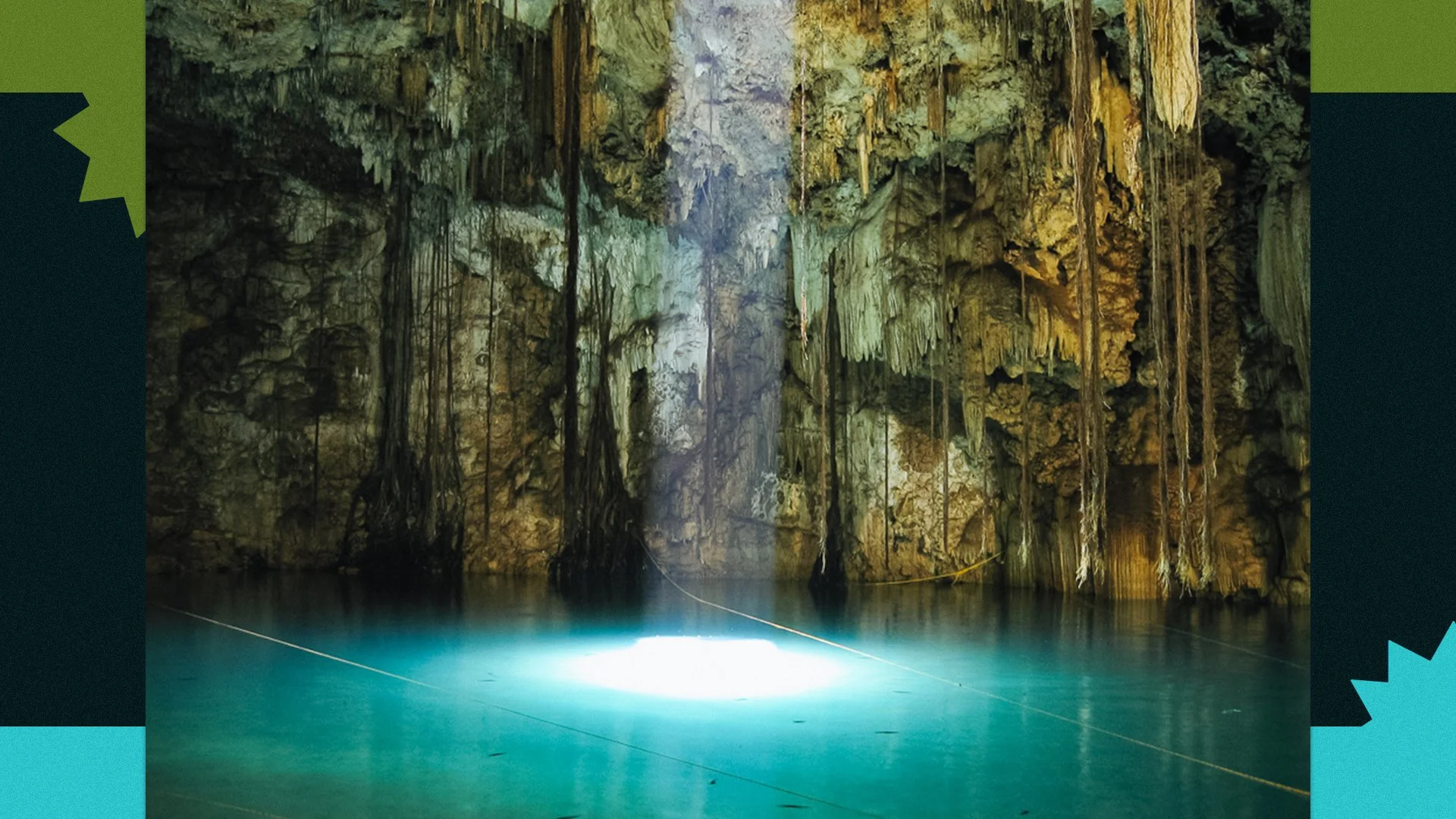
Photo Illustration: Humanizing History Visuals. Photo: lostpylon, CC BY-SA 2.0, via Wikimedia Commons
Welcome to Humanizing History™! Every month, we feature a central theme. Each week, we dive into different areas of focus.
This month’s theme: How Water Shapes People and People Shape Water
This week’s focus: Hidden History, a facts-based resource to highlight technological and cultural innovation
Today’s edition of Humanizing History™ is about 1100 words, an estimated 4-minute read.
The Why for This Week’s Topic
Imagine standing at the edge of a sinkhole, in the rainforests of the Yucatán Peninsula.
You climb down a narrow ladder. The air cools. The light shifts.
And suddenly, the ground opens into a vast underworld pool, where beams of sunlight slice through the darkness and cut into the deep, still water.
For the ancient Maya, these sinkholes, or cenotes, were not just sources of water. They were sacred.
Across time and place, many people have understood water not just as a resource, but as something to be in relationship with — something to honor, protect, and in many cases, revere.
Water sustains life. It nourishes bodies, cities, and civilizations.
And it also has nourished something less visible: belief, ritual, identity, and meaning.
This month, we’re examining how water shaped people and how people shaped water.
In Week 1, we explored how people learned to find water where none seemed to exist — at least on the surface.
In Week 2, we examined how engineers moved water across vast distances to sustain growing cities.
This week, we turn to a different kind of innovation:
How humans have honored water — not just as something to use, but as something living or sacred.
Water as Sacred: A Different Kind of Relationship
Long before modern environmental movements, many societies understood something essential:
Water was not just a resource to control.
It was something to live in relationship with, something to respect and honor.
Across cultures, water has been seen as:
A source of life, a force of renewal, a bridge between worlds.
And, in many cases, something to revere.
These beliefs shaped cultures in profound ways — influencing rituals, traditions, and entire ways of living. They also shaped how communities interacted with the natural world over generations.
The Maya and the Sacred Cenotes
In the Yucatán Peninsula — which sits on one of the largest foundations of limestone bedrock on Earth, and where rivers are scarce on the surface — water exists in another form.
Beneath the ground lies an extensive network of underground rivers and pools, accessed through natural openings or sinkholes known as cenotes.
The origins of these cenotes trace back tens of millions of years ago, when an asteroid struck this region — the same event that is widely believed to have caused the extinction of the dinosaurs.
This massive geological impact created the Chicxulub crater, which fractured the bedrock. Over time, rainwater slowly dissolved the limestone, causing the land above to further collapse — forming thousands of cenotes in the process.
To enter a cenote is to step into another world.
The air cools as you descend. Light filters in from above, illuminating the water in brilliant rays of blue. Sounds echo against cavern walls.
A series of tunnels branch into dark corners, some too narrow to pass through. Some plunge more than 150 meters deep.
For the ancient Maya, cenotes were essential for survival. They provided fresh water when no ground rivers ran. And they were also deeply spiritual spaces.
Cenotes were believed to be portals to Xibalba, the underworld where deities resided and where the human and spirit worlds could meet.
When excavating these waters, modern archaeologists have uncovered the skeletal remains of extinct megafauna (such as giant ground sloths), humans, and artifacts like jade, gold, pottery, and even a one-thousand-year-old wooden canoe.
Finding artifacts like this suggest that the Maya frequented the cenotes to make offerings as acts of devotion. In this light, entering a cenote was not just about accessing water, it was a symbolic act tied to something sacred. They weren’t casual interactions, but instead, intentional, ceremonial, and reverent.
And even if you don't share the same spiritual beliefs, you may still feel it — something ancient, something quiet, something universally resonant when entering these dark, cold waters, born tens of millions of years ago. We may just describe it through a different lens, or call it by a different name.
A Pattern Across Cultures
The Maya are not alone in seeing water as sacred. Many societies have developed spiritual relationships with water — each shaped by their environment, beliefs, and histories.
Along the Ganges River in South Asia, hundreds of millions of people gather to bathe in its waters, seeking purification of body and spirit. For many, the river is not just water, but a living presence — an embodiment of life, death, and renewal.
Across Japan, Shinto traditions include ritual cleansing with water before entering sacred spaces. The practice also emphasizes purification, presence, and respect.
For the Māori of Aotearoa (New Zealand), rivers are understood as living ancestors, inseparable from identity, genealogy, and community responsibility.
These practices may differ in form, yet they also share a common thread: water is not separate from human life — it is deeply intertwined with identity, belief, and meaning.
Bridging to Today: Water and Stewardship
When water is understood as sacred, people are often more likely to act as stewards, not just consumers.
Around the world today, some communities identify themselves as “water protectors,” emphasizing responsibility over ownership.
In 2017, for instance, New Zealand became one of the first countries to grant legal personhood to a river — the Whanganui — recognizing it as a living entity with rights, rather than a resource to be owned. This reflects the Māori worldview of seeing the river as an ancestor, often expressed as “I am the river, the river is me.”
While the language or framing may be modern — “legal cases,” “environmental policy” — the underlying idea is not new.
It echoes something ancient and perhaps universal to our global human needs: water is part of a larger system of life, one that requires care, balance, and respect to be sustained.
Let’s Pause and Reflect
Across human history, water has been more than something people simply use. It has been something many people honor, protect, and hold sacred.
How do you think about water in your own life?
Is it simply a resource, or does it hold deeper connections to culture, tradition, or identity?
What might change if the larger “we” sees water as not just something to manage, but as something we are in relationship with?
This week, consider noticing water differently — whether it comes from the tap, falls as rain, or moves through landscapes unseen.
Behind some of water’s movement lies systems of engineering and innovation, and also generations of belief, ritual, and human connection.
And across time and place, one pattern emerges: what we treat as sacred, we are more likely to protect and sustain.
Theme: