
Zheng He: Who Gets To Be Called an Explorer?
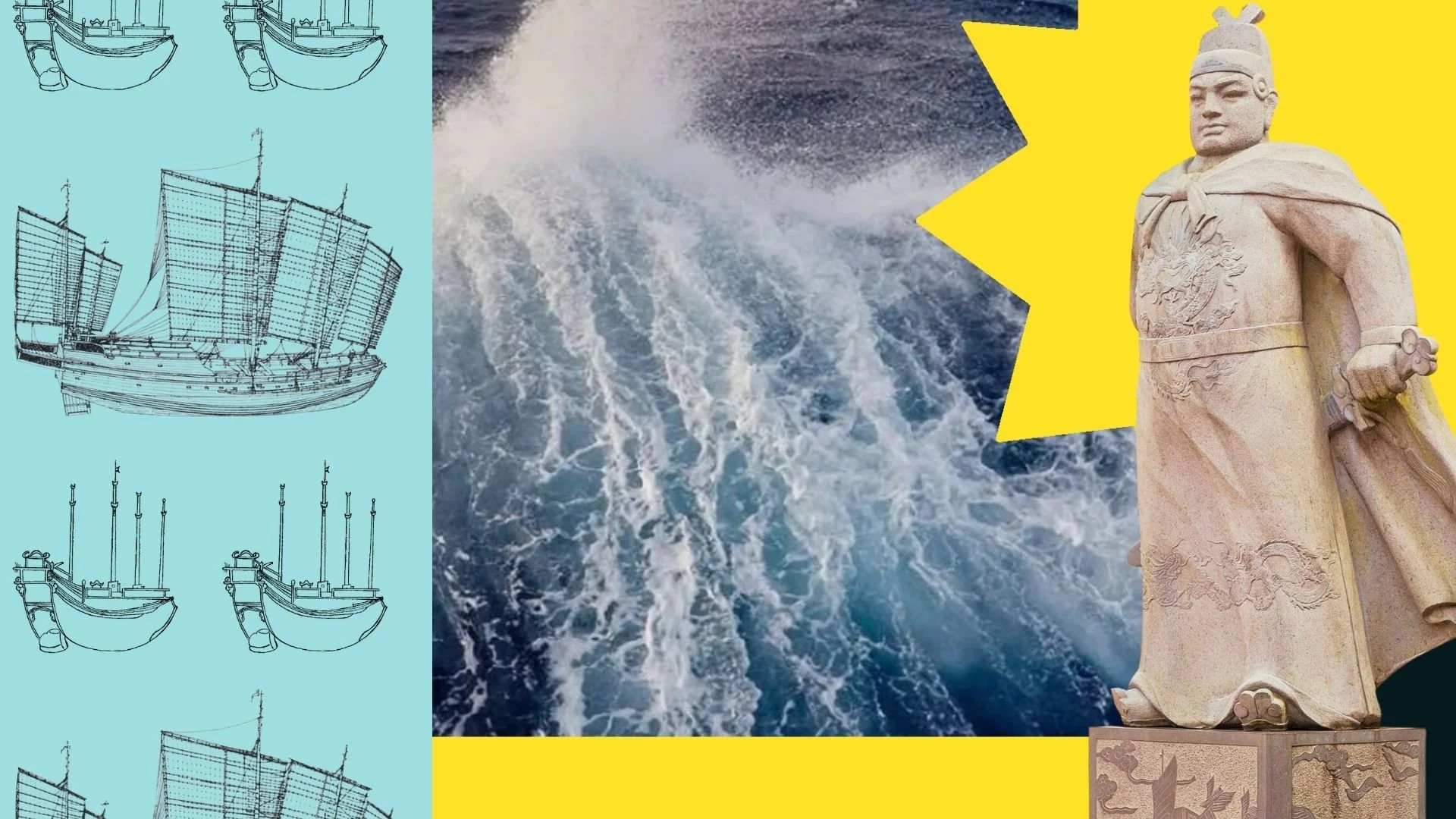
Photo Illustration: Humanizing History Visuals. Photos: NOAA/Public domain; Björn Landström/Public domain; Marcin Konsek/CC BY-SA 4.0; Li Zhaoxiang/Public domain via Wikimedia Commons
Welcome to Humanizing History™! Every month, we feature a central theme. Each week, we dive into different areas of focus.
This month’s theme: Expanding How We Teach Exploration
This week’s focus: Historical Literacy, or helpful frameworks to expand how we approach history and identity
Today’s edition of Humanizing History™ is about 1,000 words, an estimated 3½-minute read.
The Why for This Week’s Topic
Last week, we asked the question: When does exploration begin?
We looked at how the stories we inherit can shape what we see — and what we may not notice.
This week, we’ll apply the question further: What happens when we look at someone whose story may invite us to think differently about exploration?
Imagine setting out across an ocean without maps, GPS, weather forecasts, or the navigation systems many have access to today.
What would you need to know? An understanding of the stars. The winds. Currents. Seasons. Coastlines. Ships.
You would need to know how to read the environment around you — how to anticipate, how to remember, and how to communicate such knowledge.
Now imagine sailing and leading a fleet of hundreds of boats, with tens of thousands of sailors. What kind of knowledge would you need to embody?
Meet Zheng He
Meet Zheng He.
From 1405 to 1433, Zheng He, a Chinese admiral and diplomat during the Ming Dynasty, led seven major maritime expeditions.
He commanded fleets that traveled vast distances: along Southeast Asia and across the Indian Ocean, reaching the Persian Gulf, the Red Sea, the Arabian Peninsula, and the Swahili coast of East Africa.
The scale was extraordinary. Some expeditions included more than 300 ships and 37,000 sailors. The largest ships, called “treasure ships” — some the size of soccer fields — were accompanied by a fleet of boats to support an array of needs, such as “oceangoing stables” for horses and “aqueous farms” of bean sprouts in an effort to combat scurvy.
In the process, innovations from China — like gunpowder and the magnetic compass — spread to new societies. Zheng He’s ships returned to China with raw materials like ivory, gold and tin; unfamiliar animals like giraffes and ostriches; and spices like black pepper, cloves, nutmeg, ginger, and other medicinal resins that influenced Chinese medicinal practices, which were later cataloged in texts like the Ben Cao Gang Mu.
These voyages took place “almost a century before the Portuguese reached India by sailing around the southern tip of Africa,” and nearly a century before Vasco de Gama and Christopher Columbus set sail.
And yet, as one biographer points out, “Zheng He was the greatest explorer that the world had never heard of.” While Zheng He is indeed featured in some historical texts, depending on where you live, he may not be included when discussing exploration.
Did Zheng He make it to your history textbook or curricula?
An Expansive Maritime World
Zheng He’s story also includes more than the distance traveled or the size of ships. His voyages also involved embodied knowledge, diplomacy, trade, and relationships among states and empires.
The Indian Ocean was not an empty expanse waiting to be “discovered.” It was already a connected region, with established ports, trading networks, and communities whose knowledge and relationships shaped the hemisphere.
Zheng He’s story is one example of what becomes visible when we consider where we place the camera — on whose shoulders. And what that camera may reveal about the human story: who we are as individuals, how we think of others, and the stories we craft about the larger world.
And Zheng He was not alone. Many explorers have traversed the seas.
Across the Pacific, for example, Polynesian navigators developed sophisticated ways of traveling enormous distances by reading stars, winds, waves, birds, and other environmental clues.
As we explored in an earlier Humanizing History article, these systems of navigation reflect generations of accumulated and shared knowledge.
Embracing many stories can invite us to consider a shared question: What changes when we recognize that there is more than one way to know and “explore” the world?
Who Gets To Be Called An Explorer?
Was Zheng He an “explorer”? Many would say yes. He led seven major expeditions across vast distances, navigated complex maritime networks, and helped establish diplomatic and commercial connections between Ming China and communities across AfroEurasia.
And yet, Zheng He is not always centered, or even included, in the stories of exploration that students encounter — particularly those organized around a more European-centered “Age of Exploration.”
What makes someone an explorer in the first place? Is it traveling far from home? Reaching a place unfamiliar to you? Mapping a route? Developing new navigational techniques? Seeking trade, resources, or political influence? Building relationships across societies?
And who gets to decide?
The word exploration can make it sound as though a place becomes significant when someone arrives there and records it.
But the places Zheng He visited already had their own histories, knowledge systems, and connections. The people who lived there were not simply waiting to enter someone else’s story.
There is another part of this history worth considering, too. Voyages of “exploration” were not only about curiosity or exchange. They also projected imperial power, asserted political authority, and sometimes involved military force.
Broadening the story of exploration means examining both what journeys made possible and the consequences they carried — and may continue to carry.
Zheng He’s legacy also reminds us that historical memory is not fixed. After the Ming court’s priorities shifted, the support of maritime expeditions waned.
What gets remembered, taught, or left at the margins can change alongside the societies that tell these stories.
What do our definitions of exploration reveal about the stories we have learned to tell?
Applying it to Our Classrooms
When we teach exploration, we can ask more than: Who went where?
We may also ask:
What knowledge made the journey possible, and who developed it?
How was that knowledge shared, practiced, and built upon?
What did travelers learn from the people and places they encountered?
Whose knowledge, experiences, and contributions appear in the story — and whose are missing?
What were the consequences of these encounters for the people involved?
And perhaps, before we place the camera on the shoulder of an “explorer,” we can place it on the shores where “explorers” traveled to, but before their arrival so we have many stories over single stories.
Theme: