
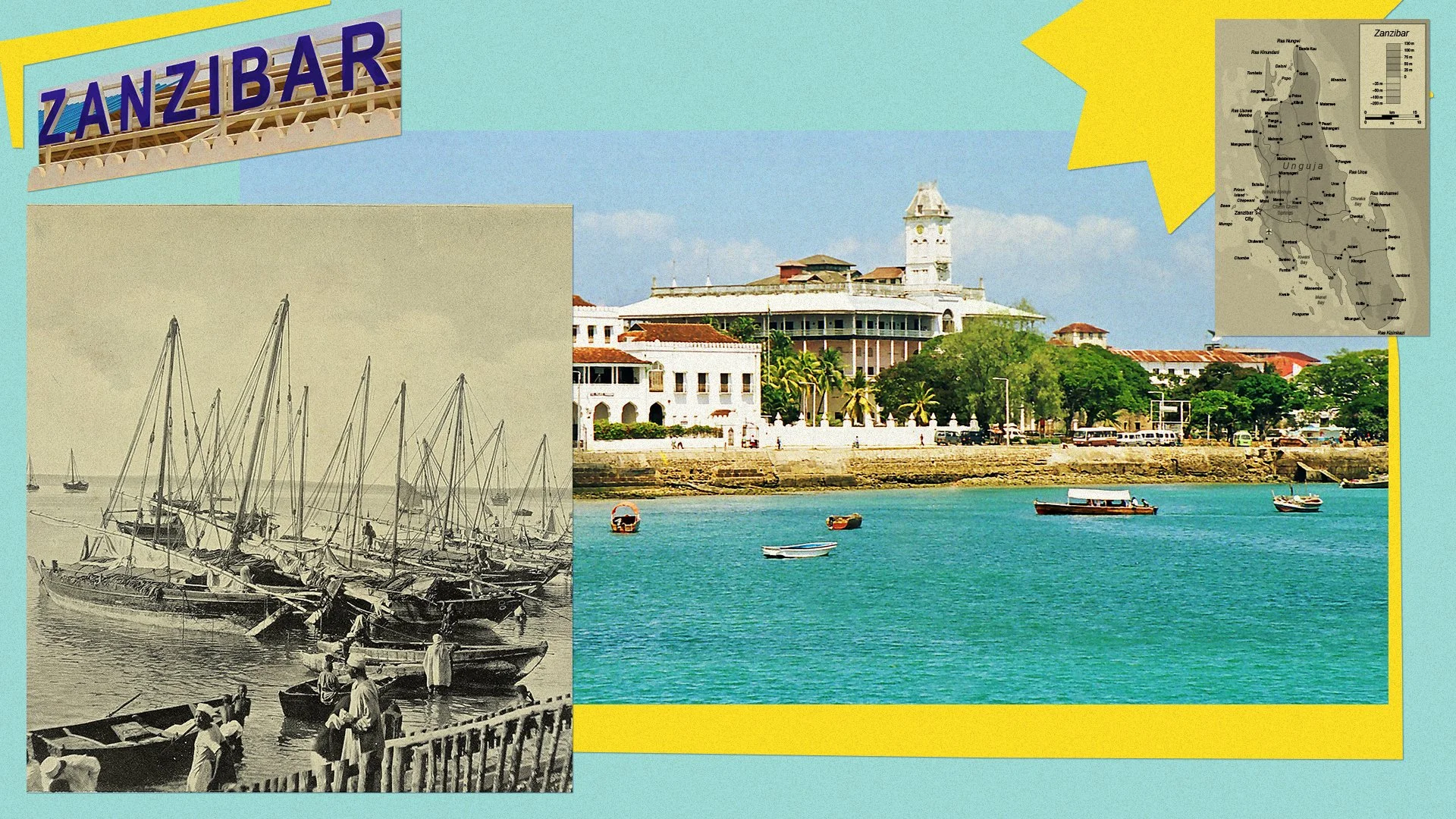
Photo Illustration: Humanizing History Visuals. Photos: Adam Jones from Kelowna, BC, Canada, Mysid, Dr. Ondřej Havelka (cestovatel), CC BY-SA 4.0, Anderson-Morshead, A. E. M, Public Domain via Wikimedia Commons
Welcome to Humanizing History™! Every month, we feature a central theme. Each week, we dive into different areas of focus.
This month’s theme: Expanding How We Teach Exploration
This week’s focus: Historical Literacy, or helpful frameworks to expand how we approach history and identity
Today’s edition of Humanizing History™ is about 800 words, an estimated 3-minute read.
The Why for This Week’s Topic
Imagine a camera is placed on a beach. There’s white sand. Turquoise water. Coral reefs just offshore.
Wooden canoes and dhows line the coast.
Swahili, English, Arabic, and other languages are spoken here.
Spices like cloves, cinnamon, and cardamom flavor local dishes.
Nearby, the buildings of Stone Town are constructed from local coral ragstone and thick lime mortar.
Goods move through busy ports.
Countless footprints, from across the globe, have traversed this shoreline.
This is Zanzibar. A place shaped by centuries of movement.
This month, we’re expanding how we teach “exploration” by asking different questions about the stories we tell.
In our first newsletter, we asked: Where does exploration begin?
Last week, we asked: Who gets called an explorer?
This week, we’re moving the camera again — from traveler to place.
We’ll ask: What happens when we look at a place shaped by generations of movement? And whose stories does it tell?
The Geography of Movement
An archipelago in the Indian Ocean, Zanzibar is anchored just off the coast of present-day Tanzania.
Seasonal monsoon winds have shaped the region. For thousands of years, sailors have learned to read and navigate these wind patterns, as well as currents, stars, and seasons — the ocean was a complex system people learned to read.
For centuries, Zanzibar was part of a much larger Indian Ocean world connecting East Africa with the Arabian Peninsula, Persia, India, and beyond.
Global influences can be seen in Stone Town, a historic merchant town located on the largest island, Unguja. Stone Town’s architectural elements — from the design of the homes and courtyards, narrow corridors, and massive hand-carved wooden doors — reflect Swahili, Indian, Arab, and European influences.
Today, in the Forodhani Gardens, vendors sell an array of seafood, from grilled tiger prawns to masala spiced octopus, topped with chili mango.
A place, like Zanzibar, is often shaped by geography and by those who moved through it — and the many cultural layers they brought with them.
Layers of Place
But the story of Zanzibar begins long before these networks of movement and trade were developed.
Archaeological evidence, like microliths, or small flint tools, points to human presence in the Zanzibar region thousands of years ago. The islands of Zanzibar were home to Bantu speakers, such as the Hadima, Tumbatu, and Wapemba.
Across the centuries, people came to Zanzibar for different reasons: to live, fish, settle, trade, worship, build, migrate, and participate in political and economic networks.
Others came through systems of political and colonial power. And some were brought by force.
Movement brings layers to a place — experienced and expressed through language, food, architecture, religion, stories, technologies, and traditions.
But those layers are not always created through equal exchanges.
Whose Stories Does a Place Hold
Some of the layers held by a place are stories of movement that people did not choose.
Zanzibar became a major center of the Indian Ocean trade of enslaved people across the centuries.
But the people who were enslaved did not arrive without identities, histories, relationships, knowledge, or cultures. Their lives, adaptations, resilience, and communities also shaped the place.
In Stone Town, Christ Church was built in the 1870s on the site associated with the former “slave market,” one of the largest in East Africa. Its construction was "intended to celebrate the end of slavery,” and the church became one of the “most prominent examples of early Christian architecture in East Africa.”
Today, this Anglican church and surrounding site hold several layers of history at once: the history of enslavement, the people who were unjustly enslaved, a movement to end the trade, European colonialism, and the religious and architectural history that followed.
A place can hold multiple stories at once. Some are visible. Some are remembered. Some take more time to uncover.
Applying it to Our Classrooms
In addition to asking who gets to be an explorer, we can move the camera from the traveler to the place they’re traveling toward. We can place the camera on the land.
Before asking who arrived through “exploration,” we can ask what — and who — was already there.
Questions to consider:
Who is Indigenous to this land?
How did geography shape life here?
Who moved through this place, and what did they bring with them?
What did they leave behind — or what did they change?
Was movement always voluntary? Was exchange always equal?
Whose stories may be easier to see? Whose might be harder to find?
Sometimes expanding a history means adding another name. Sometimes it means moving the camera. And sometimes it means asking why we chose to point it in a particular direction in the first place.
Theme: