
The Potato’s Journey, Through Mountain Landscapes to the Global Table
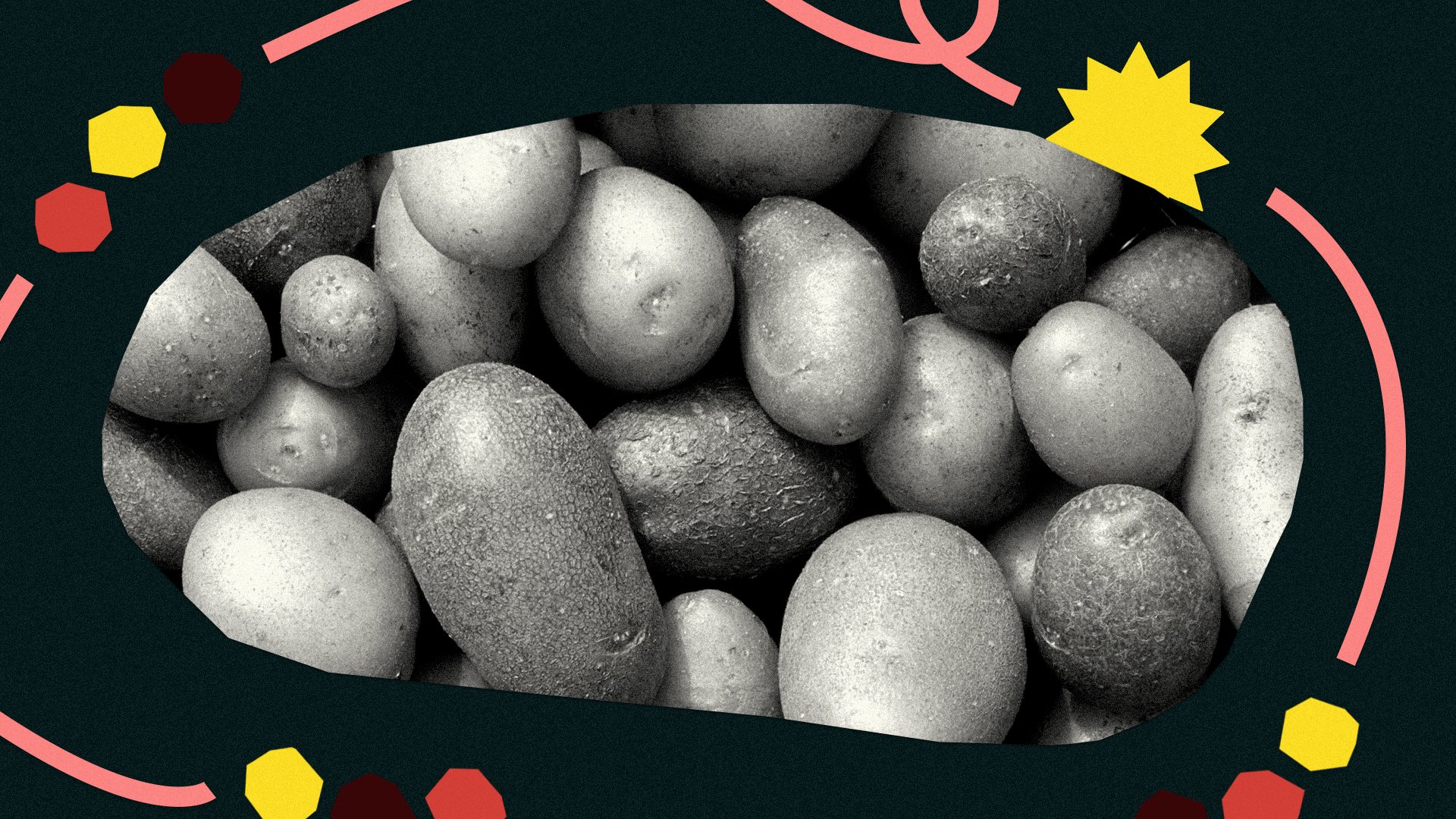
Photo Illustration: Humanizing History Visuals. Photo: Scott Bauer, USDA ARS, Public domain, via Wikimedia Commons
Welcome to Humanizing History™! Every month, we feature a central theme. Each week, we dive into different areas of focus.
This month’s theme: Origins of Food, Our Shared Human Story
This week’s focus: Historical Literacy, or helpful frameworks to expand how we approach history and identity
Today’s edition of Humanizing History™ is about 1,200 words, an estimated 4½-minute read.
Trigger Warning: This newsletter references colonization and famine. Please care for yourself as needed.
The Why for This Week’s Topic
This month, we’re examining the layered histories of familiar foods — ingredients that feel deeply rooted in various cultures yet often trace their origins to different continents, climates, and communities.
Some of these journeys include painful histories of colonization, displacement, and forced labor.
But through intentional, compassionate, humanizing storytelling, we can highlight the hands that carried seeds, nurtured soils, selected varieties, and transformed flavors.
As these weren't simply acts of nourishment or simple preference — they were acts of deep environmental knowledge, scientific expertise, and cultural innovation.
This month, we’re asking:
How do ingredients travel the globe and become part of a culture far from their origins?
Whose hands and knowledge made this journey possible?
What stories emerge when we trace the origins of the foods we may take for granted?
Last week, we explored the tomato.
This week, we turn to one of the most versatile, beloved, and globally consumed foods on Earth: the potato.
Fries, samosas, chips, shepherd’s pies, gnocchi, papas con huevos, aloo gobi, knishes, hash browns, mukimo, dumplings — the potato seems to be everywhere, across cuisines and continents.
But to understand how this tuber became a global staple — feeding more than a billion people a year — we return to its roots high in the Andean mountains of South America, where Indigenous farmers cultivated one of the world’s most remarkable crops.
The Potato as a Global Staple
But first, a bit about its impact. Today, the potato is one of the most widely consumed foods on the planet, surpassed only by a handful of staple grains, such as rice, corn, and wheat.
In many ways, the potato is ideal for wide-scale farming: it grows in diverse climates, has a relatively low production cost, stores well without refrigeration, and provides significant nutrition — vitamin C, potassium, thiamin, niacin, and fiber (especially in the skin).
Adaptable and a great source of carbs, potatoes can grow at high altitudes and low valleys — feeding families and fueling entire nations. It has shaped economies, migrations, famine, and culinary traditions.
With over 300 million metric tons of the crop produced annually, across 125 countries, the potato is seemingly everywhere. But this didn’t happen overnight. The story of a small, bitter wild plant becoming a global hope for feeding the world in the era of climate change is a story 8,000 years in the making.
Early Seeds of the Potato
The potato was first domesticated thousands of years ago in the Andean region of South America, in present-day Peru and Bolivia.
The high-altitude Andes — ranging from about 13,000–22,800 feet (4,000–7,000 meters) — can be harsh: with frigid nights, thin air, rocky soil, and dramatic temperature swings.
In response, Indigenous American farmers engineered extraordinary agricultural systems — terracing, irrigation channels, crop rotation and intercropping, natural fertilization, and communal labor networks — to make the land thrive.
The waru waru — an agricultural technique that predates the Inca Empire — was especially innovative. Engineered as raised platforms, the waru waru fields were surrounded by irrigation channels that formed “spectacular patterns.” Not only did these fields create impressive geometric forms, they created microclimates that protected crops from frost and improved soil fertility.
Across thousands of years, Andean farmers — including but not limited to the Chavín, Tiwanaku, Wari, Chimú, and the Inca — cultivated:
Thousands of potato varieties
Tubers adapted to frost, drought, altitude, and nutrient-variant soil
One of the richest genetic reservoirs for future food security
Andean farmers didn’t simply grow potatoes — they engineered them.
They also developed chuño, a brilliant preservation method in which potatoes were left to freeze overnight, thaw in the sun, and then pressed and dried over several cycles. This process removes moisture, preserving the tubers for years — an ingenious food security strategy developed millennia before modern preservation technologies.
Imagine the hands involved: planting, digging, drying, storing, selecting, tasting, refining — and eventually baking, simmering, and mashing hundreds of vibrant, nutrient-rich, colorful potatoes.
The Potato, Passing Hands
In the 1500s, the potato traveled from the Andes to Europe through the hands of Spanish colonizers.
As with the tomato, many Europeans were initially wary of the potato, associating it with poisonous nightshades.
For decades, it was primarily grown as animal feed or relegated to the diets of the lowest income groups in society.
But over time, pressures such as famine, shifting agricultural needs, and rapid urbanization led to widespread adoption.
Its ability to grow in different soils, its long shelf life, and its nutrient-dense form made the potato invaluable.
From the Andes, the potato spread:
To the Canary Islands; throughout Spain and Italy; across England and Ireland; to India, China, and across Southeast Asia; into Eastern Europe; Australia; to Russia; and back into Africa, arriving through Egypt and other parts of North Africa and spreading south of the Sahara, into nations like Kenya, Nigeria, and beyond.
Each place transformed the potato anew: into curries, stews, noodles, salads, breads, dumplings, pierogi, latkes, fries, and countless other meals.
By the Industrial Revolution, the potato had become a staple in many people’s diets, and while some of it may be celebrated, some chapters were also tragic.
In Ireland, in the 1800s, much of the population depended exclusively on potatoes: “By the early 1840s almost half the Irish population — but primarily the rural poor — had come to depend almost exclusively on the potato for their diet.” There was also a heavy reliance on one or two types of potatoes that were high-yielding.
So when a strain of water mold came through, which caused a late blight, devastating hunger took place. About a million lives were lost, and nearly two million people left Ireland. The impact can still be felt today as the current population of Ireland is less than it was in the early 1800s, before the famine.
This famine stands as a powerful, cautionary reminder: agricultural diversity is essential for resilience.
Currently, people are working hard to preserve thousands of varieties of potato. One example is Julio Hancco Mamani, a farmer in Peru, who is taking on the painstaking quest to preserve over 400 Native varieties on his own small-scale, family farm, each variety carrying its own name.
Efforts like this are what many scientists point to as the best way to secure food systems in our future, as these varieties — some drought-resistant, some flood-resistant — will be more likely to yield success in a climate-fluctuating future.
A Taste of the Past and Future
The potato, like the tomato, reminds us that food is a collective human story — shaped by movement, adaptation, creativity, survival, and strategic ingenuity.
Behind every potato dish, from masala dosas to frites, are the hands of Andean farmers who first transformed a wild mountain plant into a crop capable of sustaining complex societies and building civilizations.
On our plates, potatoes are reminders that our foods are not just ingredients; they are archives of human history — sometimes painful, sometimes hopeful, almost always layered.
So, next time you slice, fry, mash, stuff, or season a potato, perhaps pause to ask: which hands, lands, and stories made this possible?
And what can this layered story teach us about resilience, identity, and our shared future?
Theme: