
The Sound of Heritage: Rosetta Tharpe and the Roots of U.S. American Music
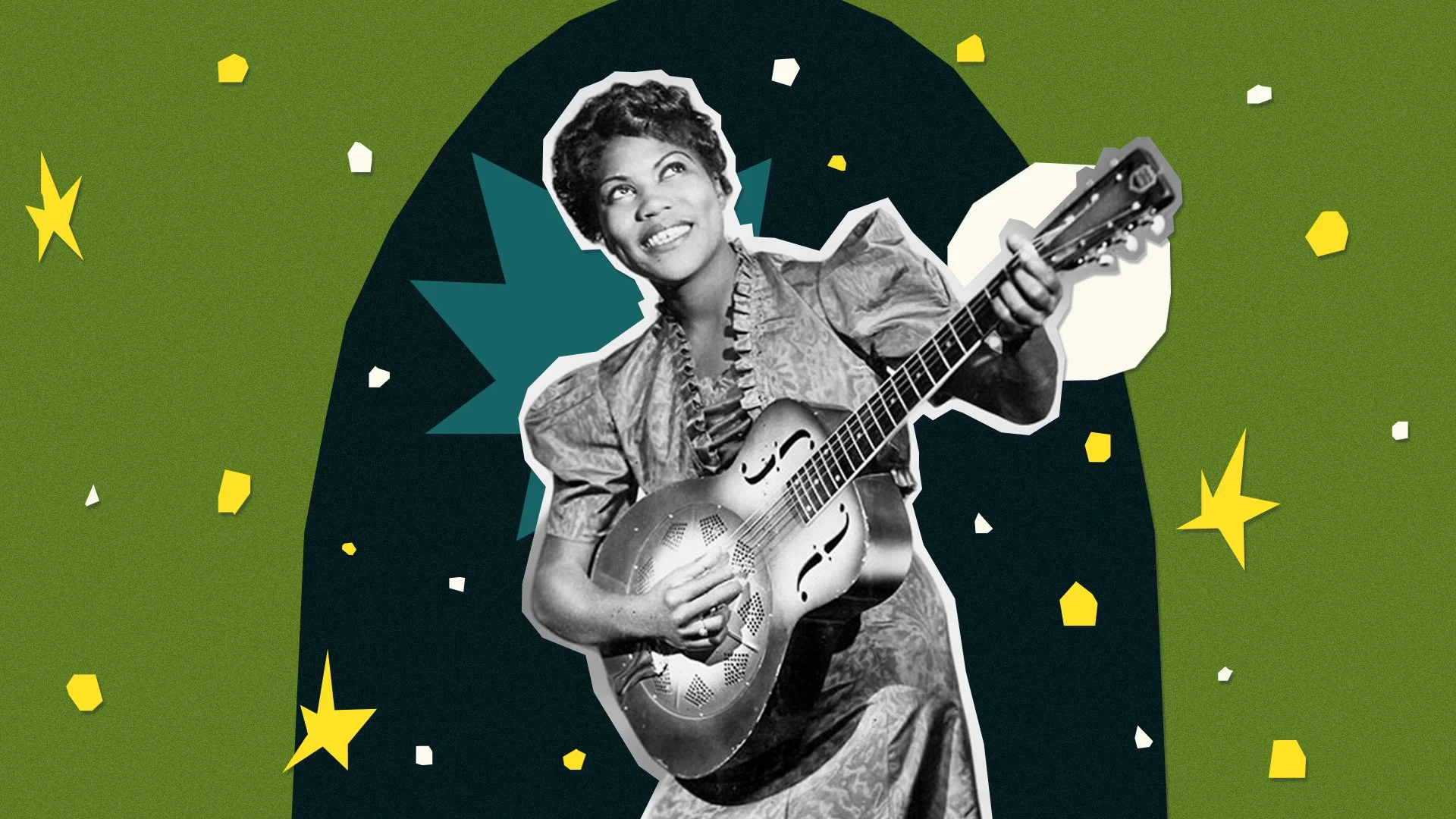
Photo Illustration: Humanizing History Visuals. Photo: James J. Kriegsmann, Public domain, via Wikimedia Commons
Welcome to Humanizing History™! Every month, we feature a central theme. Each week, we dive into different areas of focus.
This month’s theme: Heritage, Memory, and the Stories We Tell
This week’s focus: Hidden History, a facts-based narrative to highlight someone who changed history
Today’s edition of Humanizing History™ is about 1,100 words, an estimated 4-minute read.
The Why for This Week’s Topic
This month, we’re exploring Heritage Months as living, layered, expansive — as doorways, not destinations; as lenses, not containers.
In Week 1, we honored the 100-year legacy of Heritage Months through Dr. Woodson’s vision for Black history — a spark that opened doors to a century of overlooked stories.
In Week 2, we examined heritage as something alive — not static or confined, but complex, evolving, communal and deeply personal.
This week, we expand not only the lens, but the sound.
When we celebrate heritage, we often center civic leaders and political milestones.
Yet, society is also shaped in sanctuaries, on stages, through amplifiers and strings.
While her name may not be widely known, Rosetta Tharpe’s life and work helped shape what many now recognize as the foundations of rock music.
Often called the “Godmother of Rock and Roll,” her influence reaches far beyond her era.
This week, we won’t only trace Sister Tharpe’s contributions.
We’ll also explore what shaped her — and how those currents continue to echo through speakers, headphones, stadiums and streaming playlists today.
So, who was Rosetta Tharpe?
Sounds of Influence, Rosetta’s Roots
Rosetta Tharpe did more than carve opportunity, she amplified it.
Music and church were the landscapes of her upbringing.
Born in 1915 in Cotton Plant, Arkansas, Rosetta was raised by her mother, a cotton field laborer and church deaconess who supported the family through agricultural work and ministry.
By age four, Rosetta was singing and playing guitar in church. By age six, she was touring with her mother.
During the Great Migration, they moved to Chicago. From there, Rosetta performed across the United States — eventually making her way to major stages like the Cotton Club, the Apollo Theatre, and Carnegie Hall in New York City. She even filled a stadium of 20,000 in Washington D.C.
It was during this time that she became known as Sister Rosetta Tharpe.
Despite achieving national success, systemic racism shaped daily life. Often, Rosetta was unfairly denied entry into restaurants and hotels. Many nights she had to sleep in her tour bus.
Yet, in the face of injustice, her music spoke. Her voice soared.
She sang gospel. She played eclectic guitar boldly and visibly, at a time when few women — and even fewer Black women — were centered as lead guitarists.
She blended genres — fusing her gospel roots with blues lyrics and jazz rhythm. She evoked the essence of spirituals, employing call-and-response patterns, inviting the audience to join her.
Today, genre-bending music may feel normalized. In the 1940s, it was disruptive.
For a Black woman to stand on stage — in a largely racially segregated country, decades before landmark Civil Rights legislation — with an amplified guitar, singing gospel-infused words with rhythmic intensity and emotional appeal was revolutionary.
What Made Her Sound Revolutionary
Rosetta Tharpe did not invent music. She inherited a tradition, and electrified it.
Her sound carried forward musical elements rooted in the African diaspora:
Call-and-response: an interactive vocal exchange grounded in communal traditions
Polyrhythm: layered rhythmic patterns occurring simultaneously, common in Sub-Saharan African musical forms
Improvisation: spontaneous musical variation central to jazz and blues
Syncopation: emphasizing off-beats that create forward-driving momentum
Rosetta took gospel and infused it with electric, secular experimentation.
As described by the Rock and Roll Hall of Fame, Rosetta was known for her “intricate guitar technique and distortion-heavy tone” years before such distortion became iconic in rock.
In 1945, her song, “Strange Things Happening Every Day” became one of the first gospel-identified recordings to cross into the R&B charts. It included a guitar solo that is considered a precursor to rock and roll.
She influenced artists who would later become widely known as architects of rock: Elvis Presley, Chuck Berry, Little Richard, Eric Clapton, and beyond.
Some openly acknowledged the influence. Chuck Berry, when inducted in the Rock and Roll Hall of Fame, said: “My whole career has been one long Sister Rosetta Tharpe impersonation.”
See Rosetta in this video, shredding her favored Gibson guitar, a guitar type that would be used by many rock stars in her footsteps.
Her influence was not peripheral, it was foundational. And still, her name is less widely known. That gap between influence and recognition is part of what Heritage Months invite us to examine.
Music as Heritage in Motion
Rosetta Tharpe’s story reminds us that what we call “American music” is not a singular invention. It’s cumulative, diasporic, collaborative.
Contributions of Black Americans and the broader African diaspora have profoundly shaped U.S. history, including culture and music. And U.S. American music, in turn, has also shaped global sound.
Yet credit and visibility do not always follow influence.
Like heritage, music travels through: migration, labor, worship, performance, and adaptation. It transmits across places and generations.
Neither music nor heritage is static. Both live, both evolve. Both resist containment into neat, isolated boxes.
Heritage is not a solo performance, it’s an ensemble.
Expanding the Lens: From Rosetta to Today
Recognition for Rosetta came late.
In 2018 — decades after reshaping the sound of music — Rosetta Tharpe was inducted into the Rock and Roll Hall of Fame.
A musical based on her life, Shout, Sister, Shout!, premiered in 2023.
We highlight Rosetta because society is shaped not only by lawmakers and political leaders, but by artists, by sound. Heritage Months can expand to hold them all, including the cultural architects.
Like Jim Thorpe, Rosetta Tharpe was “more than a first.” Her life resists neat categorization — she sang gospel and rock, she expands what we may imagine when we think of a guitar hero or rock legend.
Sister Tharpe’s impact cannot be measured solely in chart rankings or awards. It lives in guitar techniques replicated across decades, in the countless stage performances modeled after hers, in the immeasurable echoes of what we often collectively recognize as rock and roll, and the genres that continue to spill outward.
Sometimes legacy is not only archived — it’s absorbed and continues to play in the melodies we hum but may not be able to name.
Let’s Pause and Reflect
When you think of Heritage Months, whose stories first come to mind?
What stories might deepen the picture if we widen the frame?
What shifts when we trace influence instead of spotlighting fame?
How might music, art, and culture expand our understanding of heritage beyond political milestones?
What sounds in your own life carry histories you may not have previously noticed?
Honoring heritage can include following roots and routes, what came before and what grew after — so we understand culture as layered, living, interconnected, and something that often resists containment.
Next week, we’ll explore what happens when identities and histories refuse singular labels and how that reshapes our understanding of belonging.
Theme: