
Learning to Read the World, The Power of Identity-Based Literacy
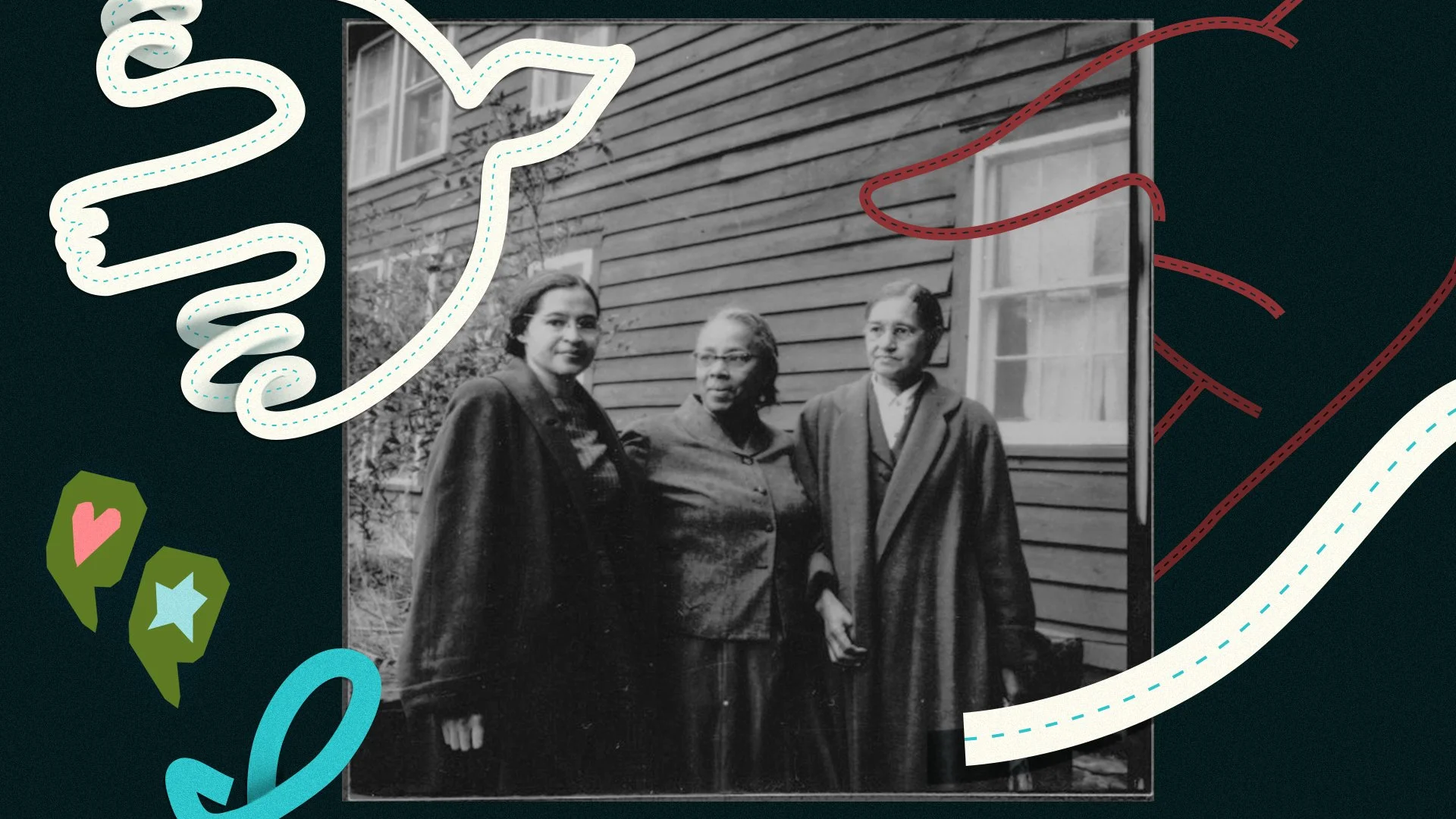
Rosa Parks, Mrs. Septima Clark, Mrs. Leona McCauley, Highlander Folk School, Dec. , 1956. [Monteagle, Tennessee]. Photo Illustration: Humanizing History Visuals. Photo: Library of Congress.
Welcome to Humanizing History™! Every month, we feature a central theme. Each week, we dive into different areas of focus.
This month’s theme: When the Outside World Enters the Classroom, Teaching in the Middle of History
This week’s focus: Hidden History, a facts-based narrative to highlight someone who changed history
Today’s edition of Humanizing History™ is about 1,400 words, an estimated 4½-minute read.
The Why for This Week’s Topic
This month, we’re exploring what happens when powerful events enter the classroom — moments that are immediate, emotional, and impossible to ignore.
In our first newsletter, we examined what it means to pause and hold space when the world barges in — through a news headline, tragedy, or charged questions.
Using examples like teaching after 9/11 and Dr. King’s assassination, we focused on the first step: making space for Big Feelings.
Last week, we looked at the second step: creating guidelines and guardrails.
Our goal isn’t to shut down conversation, but to guide it with care and responsibility.
When teaching traumatic or charged history, or current events, structure isn’t a constraint — it’s a safeguard.
This week, we’re shifting our focus to literacy as liberation —
We’re exploring how identity-based literacy invites students to connect history and current events to their own lives and communities. It affirms who they are and empowers them to shape their own stories and their place in the larger world.
But What Is Identity-Based Literacy?
Literacy often includes reading and writing skills — but identity-based literacy is about more than decoding text.
It’s an approach that connects how we learn about history and the larger human story to our lived experiences and identities.
When designed with intention, an identity-based curriculum invites students to see themselves as agents of their own learning. It exposes them to stories they can connect with — a model that recognizes learning is deeply personal and powerfully collective.
It’s an expansive approach to what and how we teach, opening pathways for agency, reclamation, and self-determination. It supports learners in understanding themselves, others, and society with greater depth and empathy.
In this way, literacy also becomes a tool for civic awareness and engagement — essential for sustaining a multiracial democracy and nurturing critical thinking in the classroom.
To grasp these dual powers of literacy — both the literal skills like reading and writing, and the broader power of understanding ourselves and others — we can leverage stories and connection.
We’ll begin by unearthing the story of someone whose name rarely makes the history books, but whose fingerprints shape much of the 20th century: Septima Poinsette Clark.
Knowing her story may change the way we see our own.
“Literacy as Liberation,” Septima Poinsette Clark’s Citizenship Schools
In the Jim Crow South, literacy — in the most basic, literal sense of reading and writing — was systematically denied to many Black Americans. Septima Poinsette Clark aimed to change that. And she did.
Her goal wasn’t just to help Black Americans pass the “literacy tests” required to register to vote — a documented form of voter suppression — but to empower people to claim their full rights as citizens, including providing access to education and self-determination.
Through the creation of Citizenship Schools, Clark taught practical, real-life skills, lessons on: phonics for adults who had been denied literacy; learning to read bus schedules; and frameworks for civic engagement, or details on voter registration, writing petitions and interpreting laws. And she grounded such lessons in dignity, respect, and cultural pride, or as Clark stated, “literacy as liberation.”
But Clark’s story begins long before those lessons.
Born in 1898 in South Carolina — just decades after the legal end of slavery — Clark was the daughter of a mother who worked as a domestic and a father who had been enslaved.
She grew up in a society built on legal segregation, where racial separation and systemic inequality were not only common, but codified into law.
Despite those barriers, Clark was determined to earn a formal education — graduating from the Avery Normal Institute, an independent school for Black students, in 1916.
But because South Carolina’s public schools barred Black educators from teaching, Clark began her career in a rural district on John’s Island, South Carolina.
There, she developed a teaching style that centered her students’ lived experiences — honoring their voices, grounding lessons in what mattered to them, and approaching education as a tool for both personal growth and collective action.
Jon Hale, history professor, speaks to Clark’s identity-centered teaching style: “Septima Clark’s method of teaching was very innovative. It was progressive. It was ahead of its time. And she learned this method from John’s Island. And that is essentially meeting her students where her students were, but also treating her students — particularly adult students — with tremendous respect.”
Clark’s approach expanded when she joined the Highlander Folk School in Tennessee — a grassroots education center known for its racially integrated workshops during the 1950s. This made it, as historian Katherine Mellon Charron notes, both “unique and a target.”
Charron describes Clark’s focus on literacy as liberation: “[Clark] operated on the philosophy that oppressed people know the answers to their own problems… that the most important thing is to develop local leaders — people in their communities who could assume a leadership role in getting things done and solving community problems.”
From this foundation, Citizenship School grew — blending basic literacy with civic education and leadership development. And the impact was far-reaching.
Rosa Parks attended one of Clark’s seminars just months before her famous act of resistance on a Montgomery bus, a moment widely recognized as the catalyst for the mid-20th century Civil Rights Movement.
And there’s Esau Jenkins, a farmer and bus driver, who taught passengers on his route how to read using what he learned from Clark.
In this context, literacy was not confined to classroom walls; it moved with people — on buses, in churches, across kitchen tables — into community and action.
Clark’s model spread. With support from the Southern Christian Leadership Conference (SCLC), Clark helped train over 10,000 teachers. By 1969, it’s estimated Citizenship Schools had helped over 700,000 Black Americans register to vote. Yes, 700,000.
Dr. Martin Luther King, Jr. called her the “Mother of the Movement.” Her legacy proves why.
Clark’s work was never just about reading. It was about reshaping the narrative people held about themselves — and each other. It was about voice, power, and possibility.
Education Can Change the World
An educator arguably helped shift the arc of U.S. history — not through a headline-grabbing spectacle, but through radical care, rooted in affirming identity.
Her example reminds us that teaching can lead to social change, and that literacy — when connected to who we are — can be a pathway to liberation.
There’s something powerful about encountering a story like Septima Clark’s.
Learning her story invites us to reflect on our own. Where do we see ourselves in her journey — as educators, students, as people navigating our own sense of identity and doing our best to safeguard and celebrate it.
This is a crucial part of identity-based literacy: finding ourselves in stories that were hidden or less known, and recognizing that the act of learning them isn’t just academic, it’s a practice of rehumanization.
When we honor stories like Clark’s, we begin to write the limits of who we believe can shape history — including making room for our own impact.
Let’s Pause and Reflect
Literacy is not just decoding sounds, or letters or words, it’s about learning to read the world — starting with how we engage ourselves, how we consider others, and whether or not we aim to expand how we tell the stories (past, present, future) of the larger world.
Whose stories show up most often in your curriculum?
Whose stories are relegated to the margins, or missing?
What would it mean to bring them in with care and expansive context?
What’s one small shift you can make this week to honor the identities in your classroom, not just as theory, but in daily practice?
When students see themselves in history — not just as passive observers but as meaning-makers — learning becomes a form of power.
Septima Clark embodied this. So do other educators around the world.
Identity-based literacy isn’t just about inclusion, it’s about truth-telling. It’s about developing the skills and self-awareness that can change lives. It’s knowing that honoring our students’ full humanity — their intersecting identities, their histories, their voices — should carry the same weight many give to standardized tests.
Next week, we’ll examine how students can be co-creators in expanding how we tell the human story and how to curate a space — soidentity is not a barrier to learning, but our starting point.
Theme: